A WORKSHOP WITH YAZAKI CORPORATION · 21 APRIL 2026 · BANGKOK
Yazaki
×
MonstarX
A two-hour working session on how your teams build enterprise software — and what the layer above the tool looks like.
presented by

WHO'S IN THE ROOM · 21 APRIL 2026
Participants.
Eleven of us, across two organizations.
Singapore
Saad Kamal 🇦🇺 🇸🇬
Product Owner, MonstarX
MD, Monstarlab Singapore
Yanyee Wong 🇸🇬
General Manager
Saad Bin Amjad 🇲🇾
Technical Director
Growth Markets
Kohei Aramaki 🇯🇵 🇲🇾
Head of Growth Markets
Thailand
Takeshi Heta 🇹🇭
Head of Monstarlab Thailand
THAI YAZAKI · YIC ASIA PACIFIC
06
Saegusa-san
General Manager
Approves overall strategy
Phongsak-san
Department Manager
IT Strategy · Application Development & DX
Chaiwat-san
Department Manager
IT Strategy · Infrastructure
Jarupun-san
Section Manager
Project Manager
Auttapon-san
Section Manager
System Design
Nanthawat-san
Staff
Developer
HOUSEKEEPING · BEFORE WE BEGIN
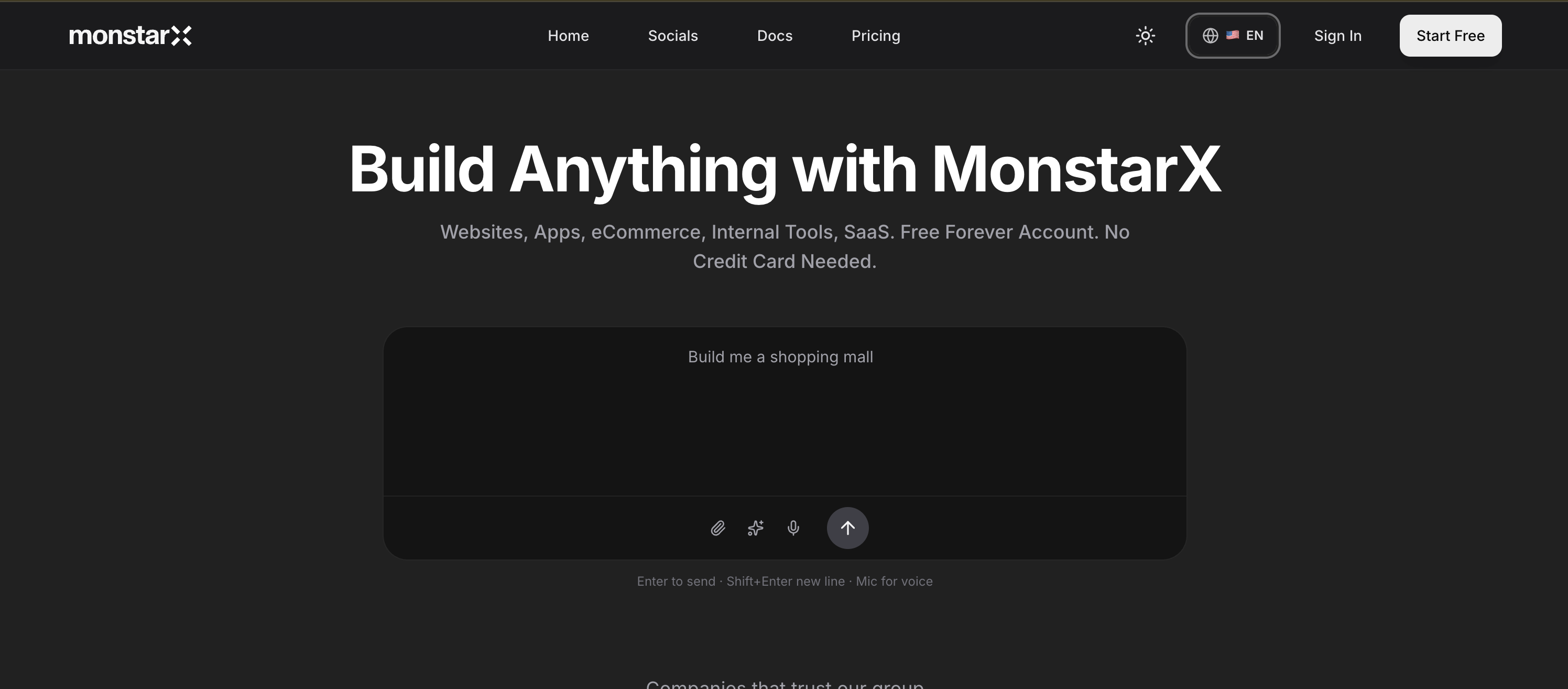
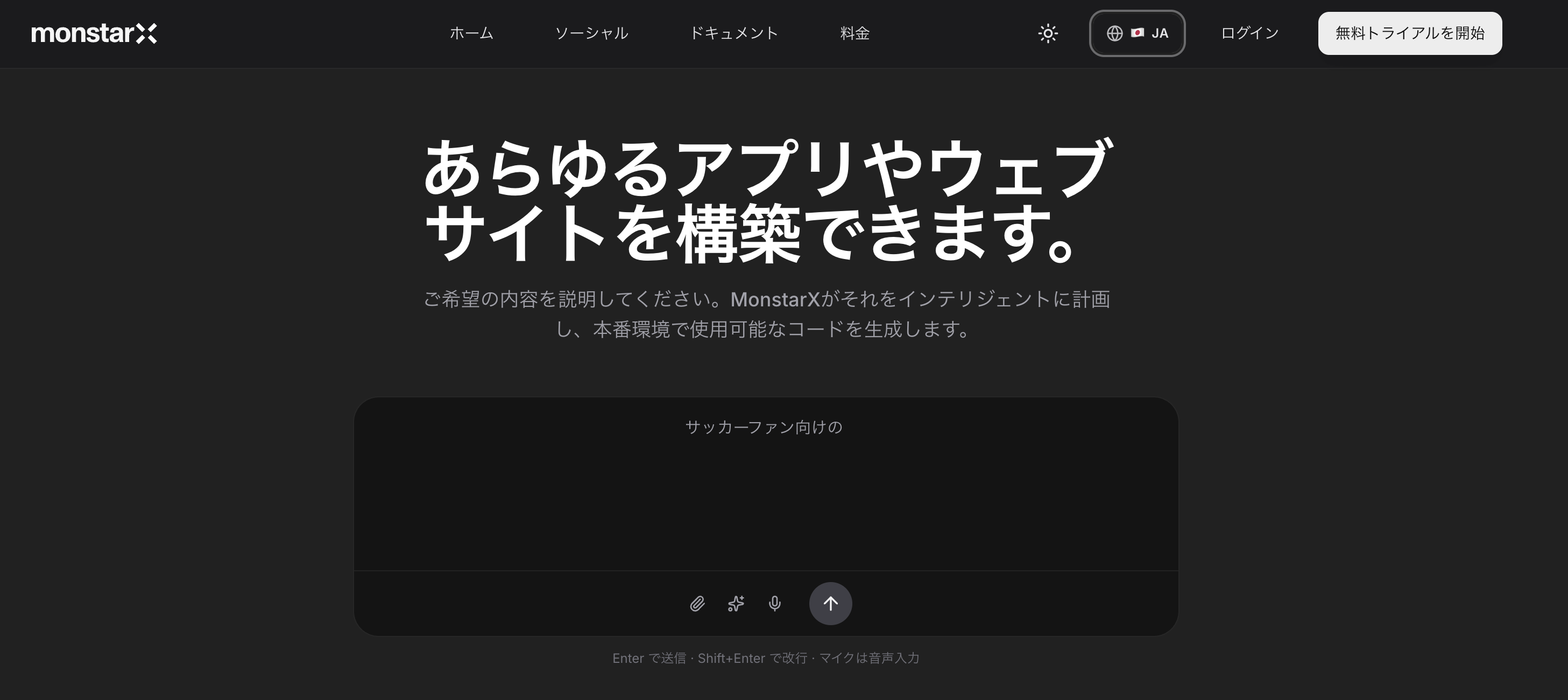
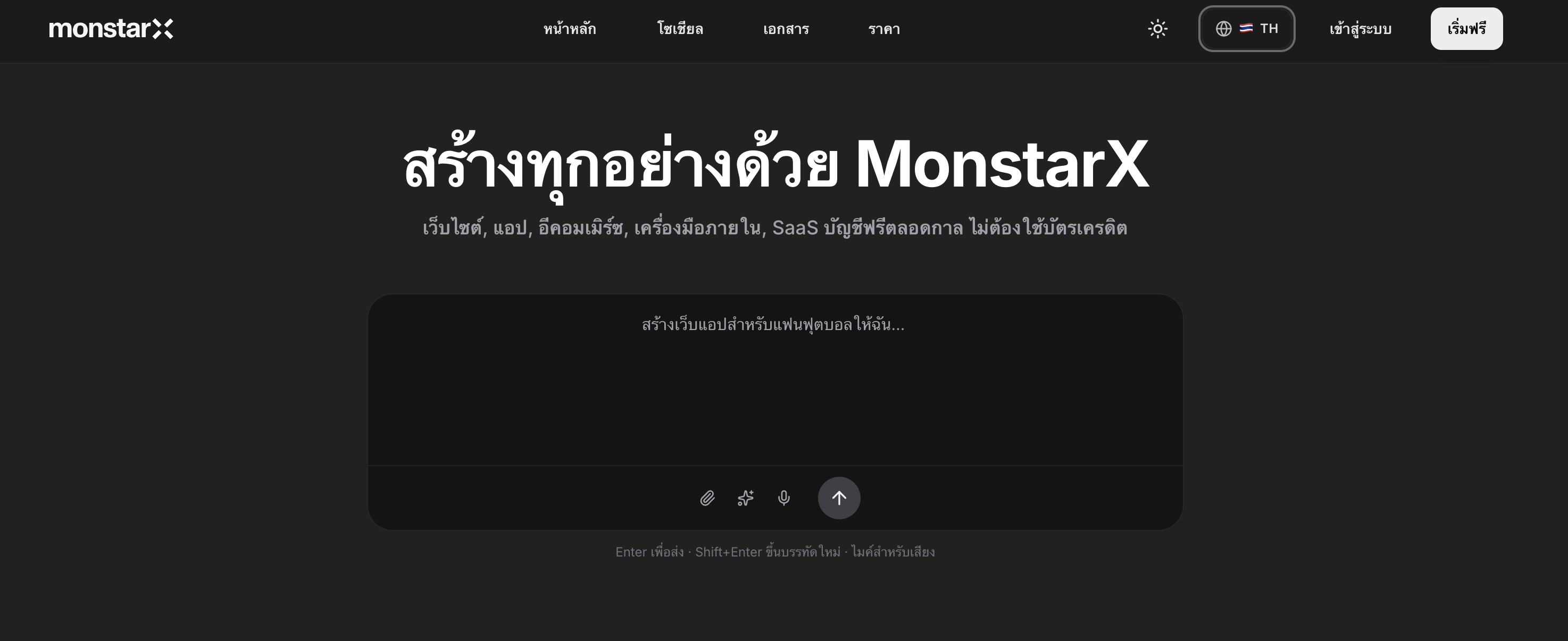
Follow along — in your language.
We have English, Japanese, and Thai speakers in the room. If it helps to read along on your own screen while I speak, open the deck on your laptop or phone and pick your language.
Open on your device
yazakideck.monstarx.com
Then choose
🇬🇧 English · 🇯🇵 日本語 · 🇹🇭 ไทย
Your selection is remembered on your device. Switch languages any time from the corner.
TODAY · TWO HOURS · SIX OF US
A working session, in seven movements.
01
The honest state of AI in the enterprise
15 min
02
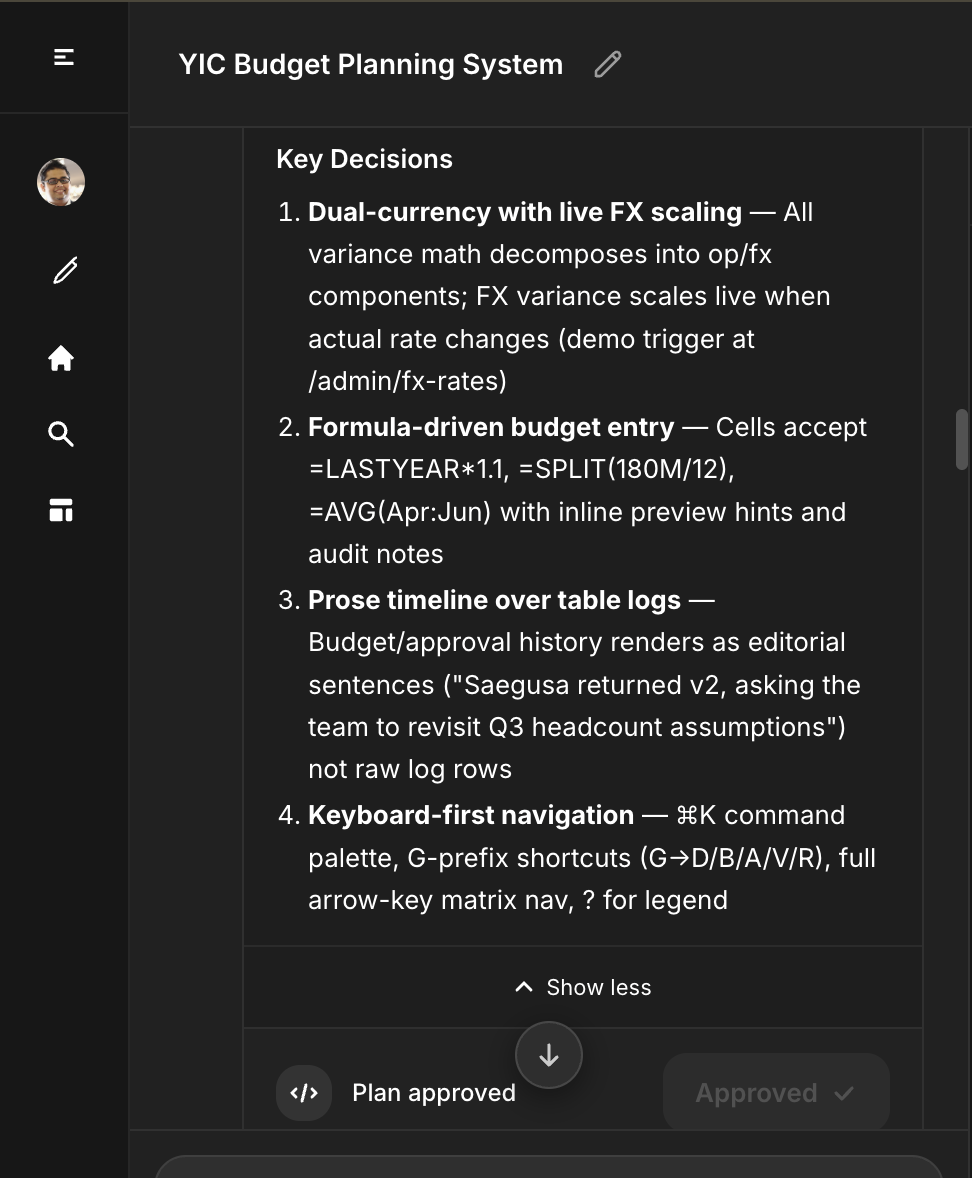
A working proof — YIC Budget Planning
40 min
03
Your turn — twenty minutes of hands-on
20 min
04
What breaks at scale
10 min
05
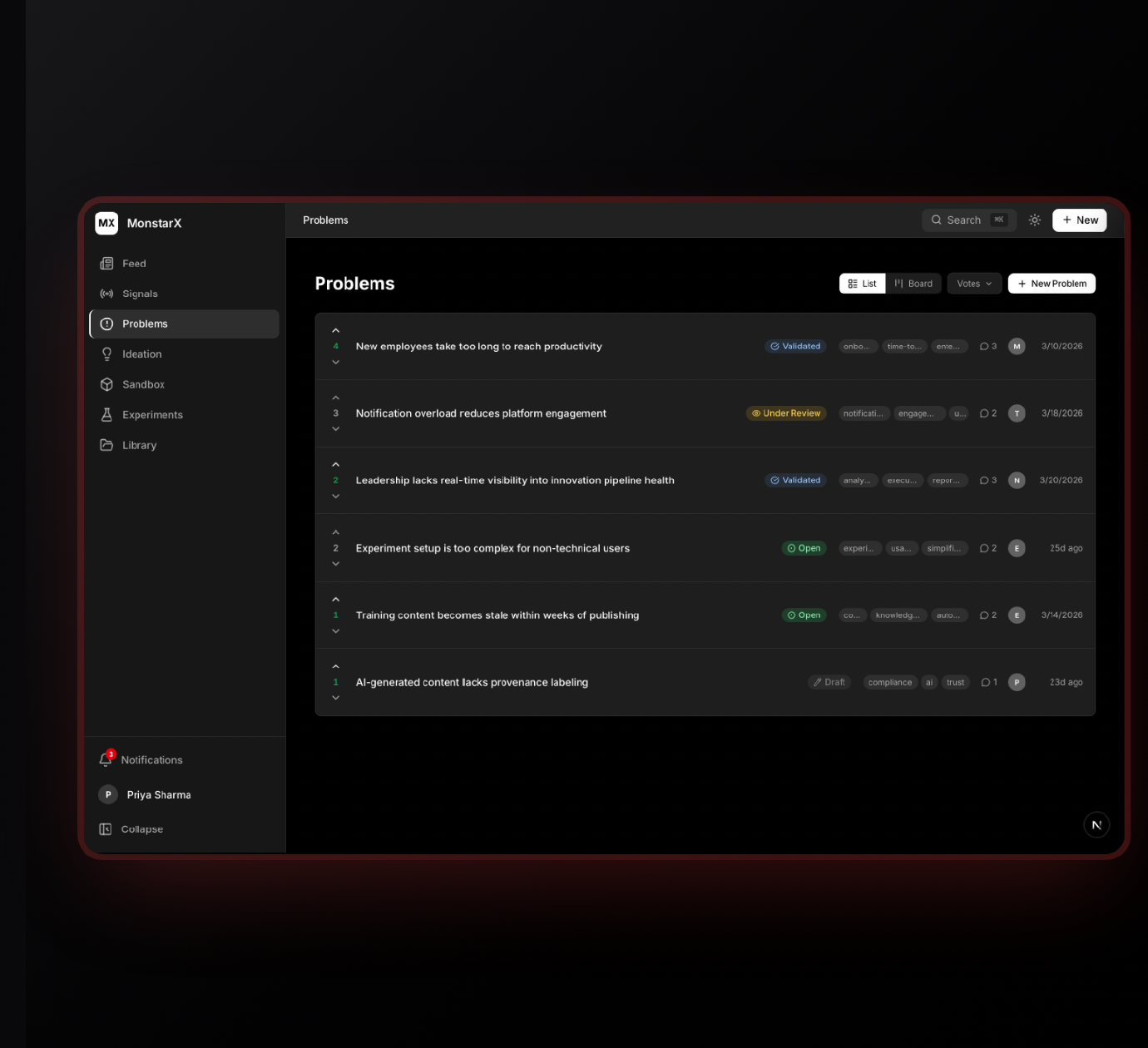
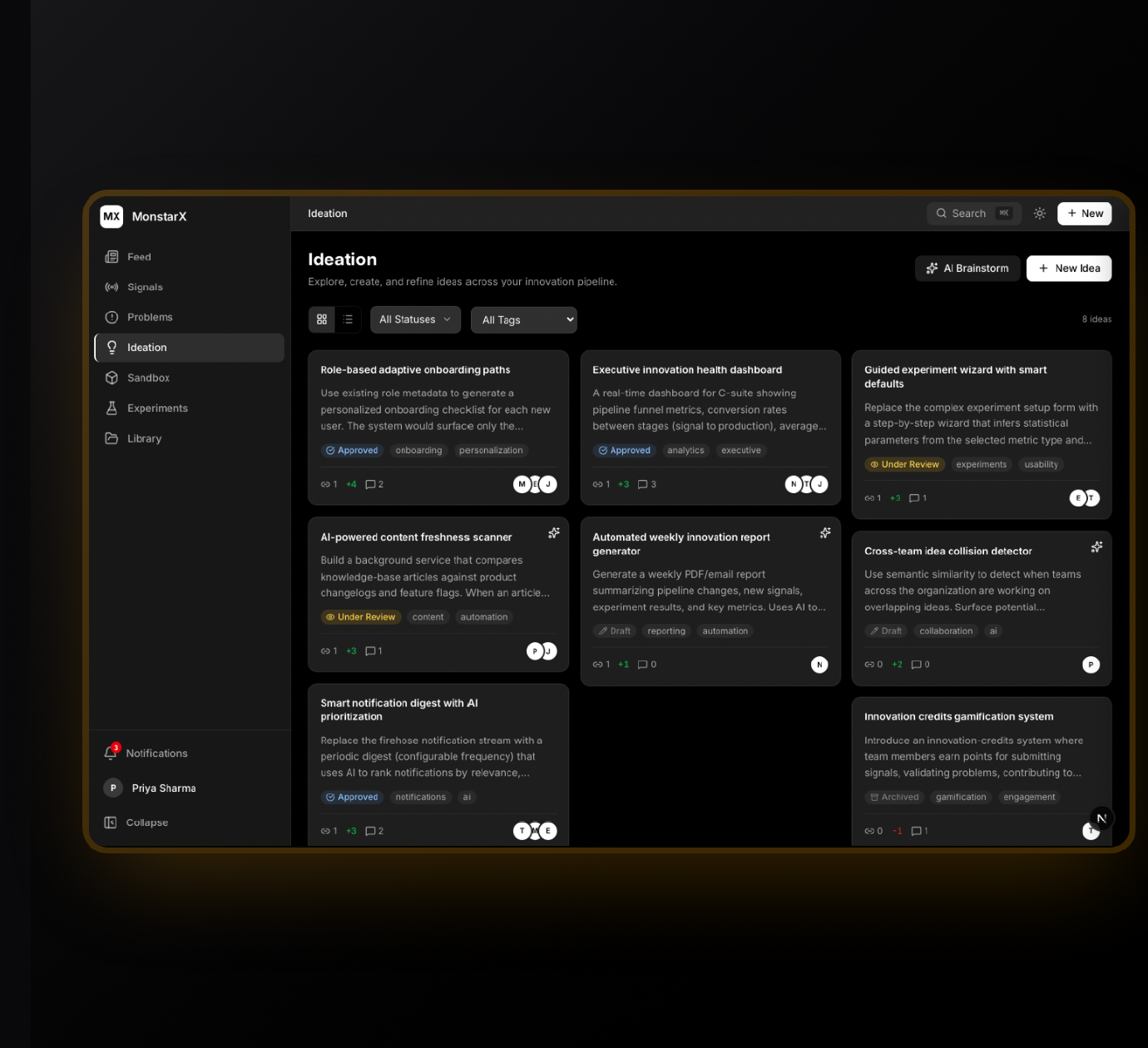
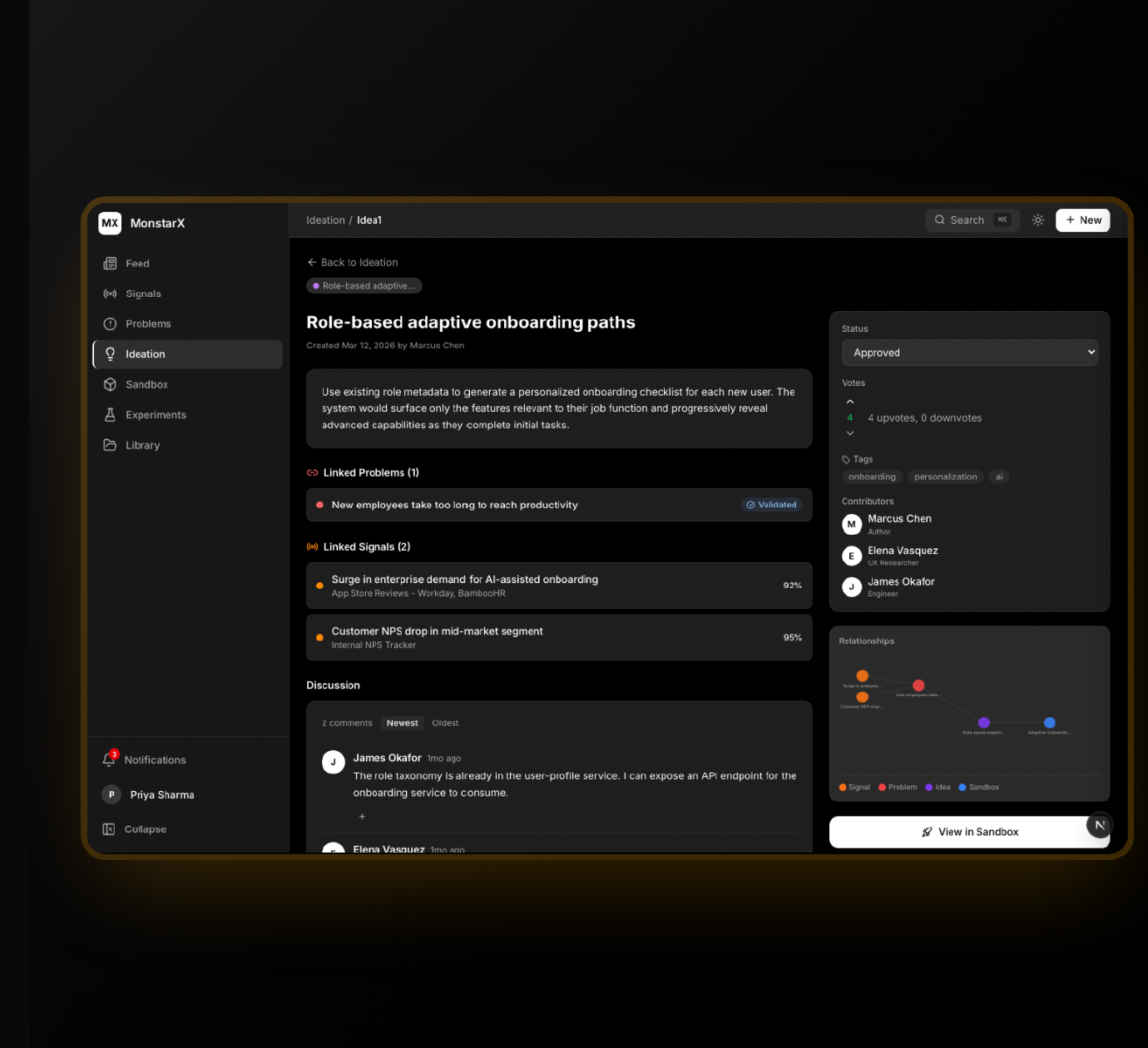
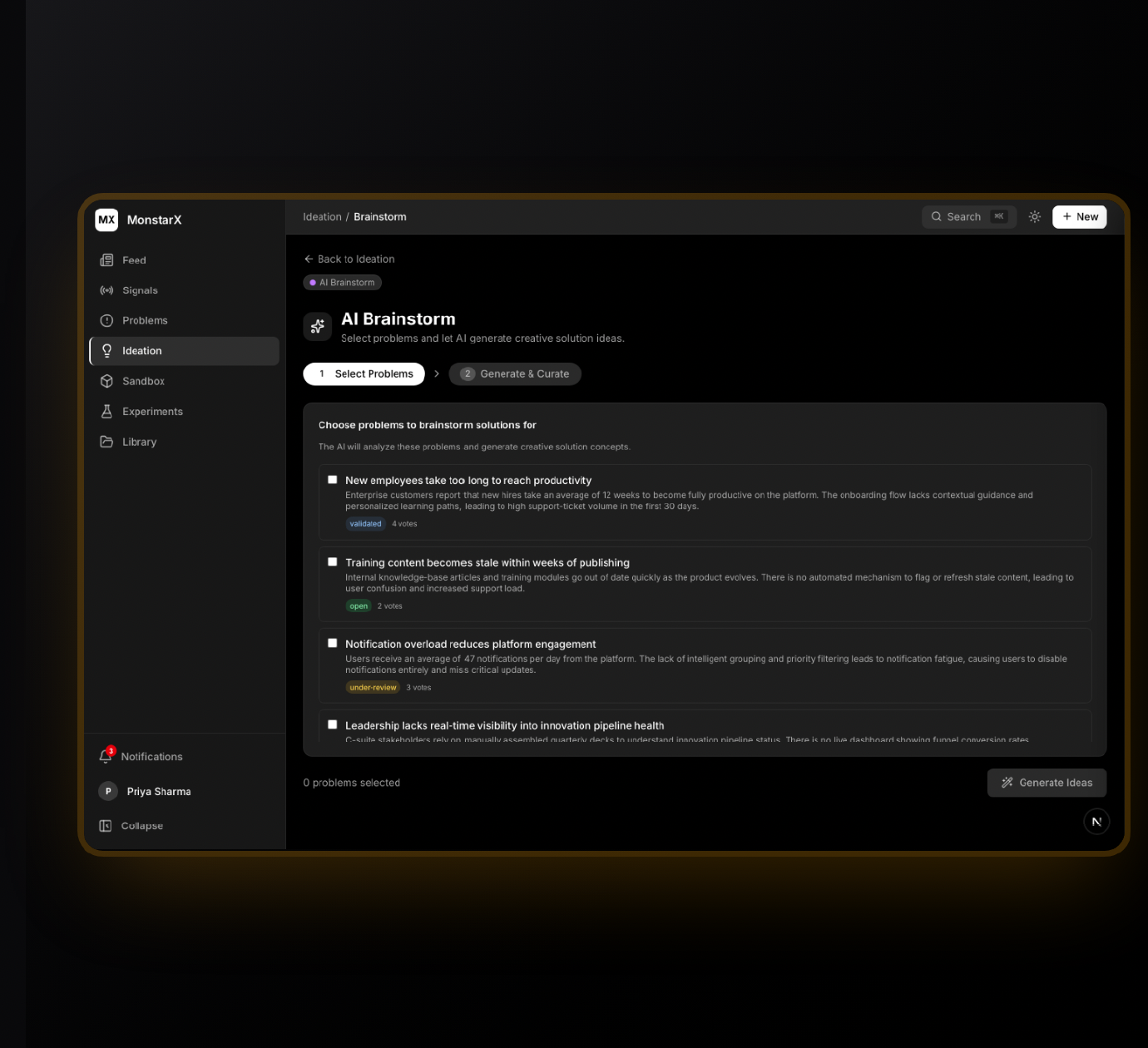
Innovation OS — a tour of the product
20 min
06
A path from today
10 min
“
AN HONEST WAY TO START
Your team is clearly AI-literate.
I'd be surprised if you weren't already testing several tools on real work.
That's why I want to spend the first fifteen minutes explaining why none of them — including ours — will solve the real problem.
THE TOOLS YOUR DEVELOPERS LIKELY USE
Your developers are probably using some of these.
Claude
AI pair programmer
For engineers
Cursor
AI-native code editor
For engineers
GitHub Copilot
Inline code completion
For engineers
Genuinely excellent tools. They make individual developers faster — and that is real.
But every one of these is a tool for developers.
The bigger question — the one your July project is really about — is whether your
non-developers can finally build.
And build in the language they already think in.
WHERE GOOD IDEAS COME FROM
Innovation never happens
top-down.
Not in any industry. Not in yours.
The best ideas come from the people closest to the problem — the line operator, the finance clerk, the quality inspector. Your teams already know what's broken. What they've never had is a way to build.
OPENING · THE GROUND WE'RE STANDING ON
現場
หน้างาน
G E N B A
the place where the work happens
“
AN ARTICLE OF FAITH IN JAPANESE MANUFACTURING
At the GENBA,
the facts are known.
Taiichi Ohno
Founder, Toyota Production System
THE QUESTION THIS WORKSHOP IS REALLY ABOUT
Why has the GENBA (front-line employees)
never been able to build
their own tools & software?
The reason was not cultural. It was technical. That has changed.
WHAT CHANGED
Something shifted in the last two years — and accelerated in the last six to twelve months.
Non-developers can now build working software — in minutes, in their own language.
11+
more languages
supported
Fully localized — end to end. A quality inspector in Rayong doesn't need English to build something for herself. That is the difference between "anyone can build" being a slogan and being true.
A PRODUCT DISCOVERY FRAMEWORK
Seven questions, before you build.
A synthesis — drawn from Amazon's Working Backwards, Y Combinator's founder questions, and the Lean Canvas. Answer all seven in one sitting — or don't start.
01 – 07
the build brief
01THE SOLUTION
What do you want to build?
Describe it in one sentence. If you can't, it's not ready.
02THE USER
Who are you building it for?
A real person in a real role, with a real context. Not "everyone."
03THE PROBLEM
What problem does it solve?
Named, observable, painful enough to act on. If no one complains, it isn't a problem yet.
04THE STATUS QUO
What's running today — and what's wrong with it?
Every problem has a current solution, even if it's Excel. Know it before you compete with it.
05THE DIFFERENTIATION
Does your solution actually close those gaps?
Not "better" — better where, exactly. Map each gap to what you do.
06THE WHY-NOT-ALREADY
Why hasn't someone already built this?
If it's obvious, they probably have. If they haven't — the conditions just changed.
07THE SUCCESS
What does success look like a year from now?
Describe the world, in the voice of the user, in one paragraph.
Then,
and only then —
build.
WHAT AI ACTUALLY READS
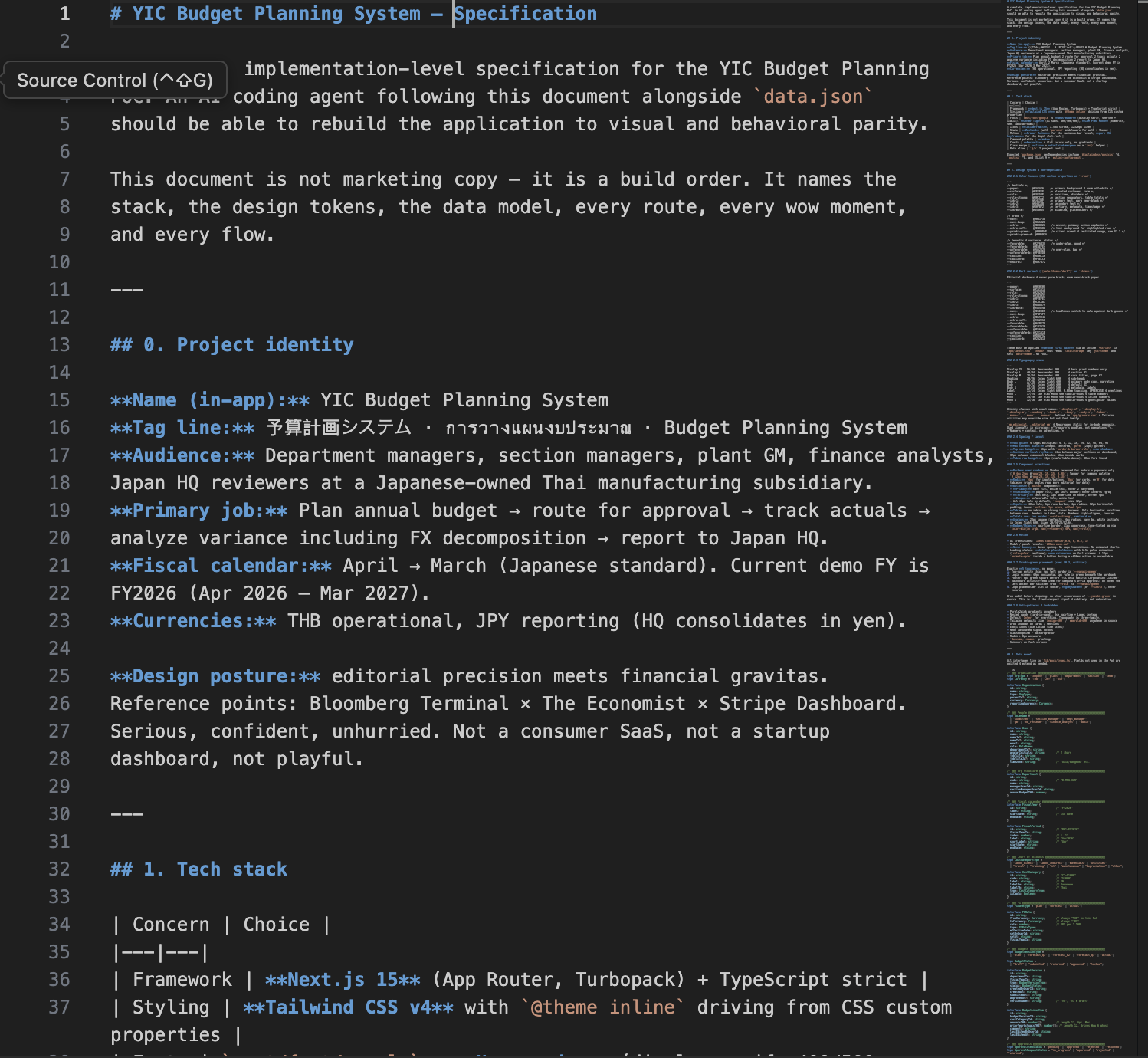
Anatomy of a requirements.md.
Six essential sections. A basic one fits on two pages. A production-grade one runs fifty. The structure is the same.
01 – 06
the build order
01IDENTITY
Name. Audience. Voice.
"Budget planning for a Japanese-owned Thai subsidiary. Editorial, unhurried."
02STACK
Framework + the libraries that matter.
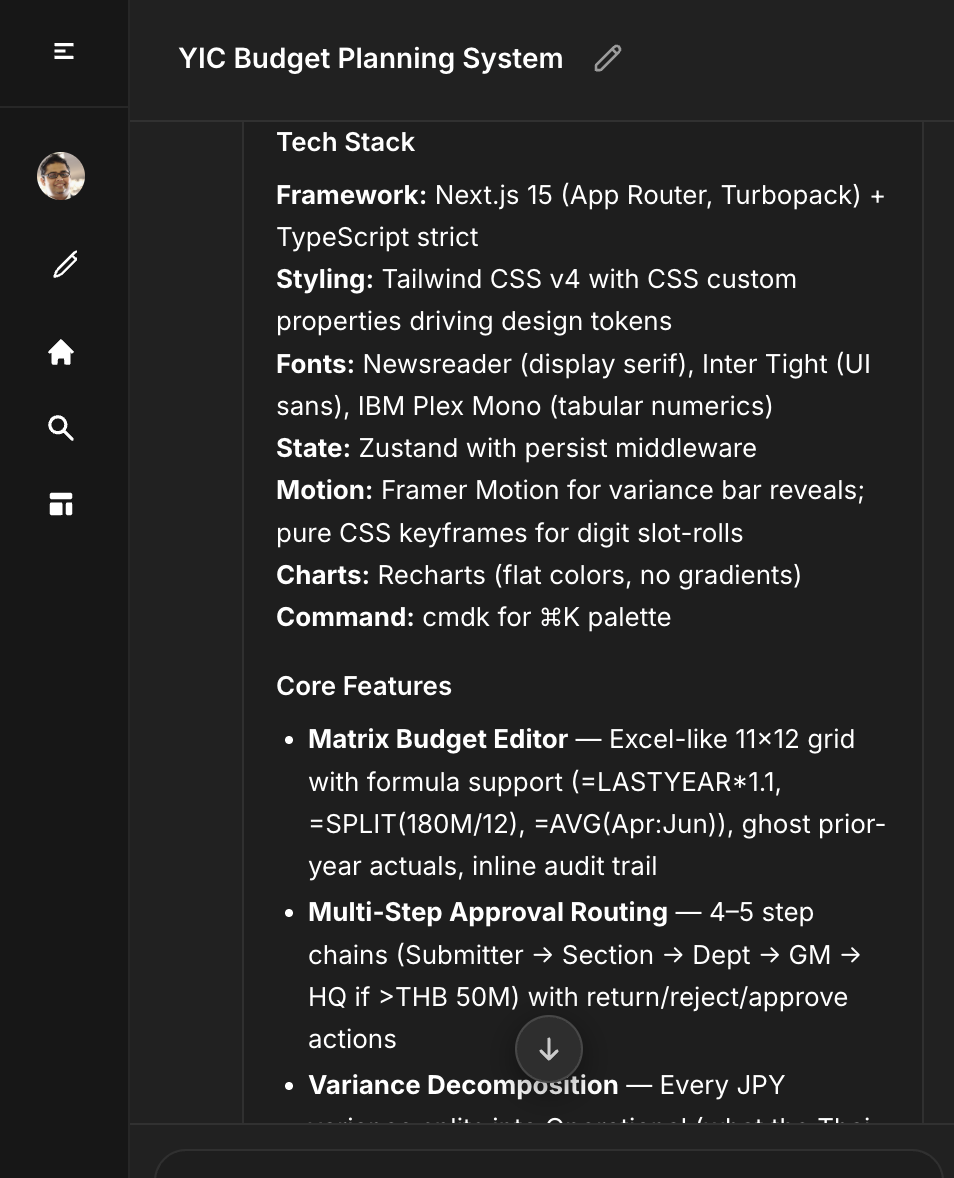
Next.js 15 · Tailwind v4 · Zustand
03DESIGN TOKENS
Colors, fonts, spacing.
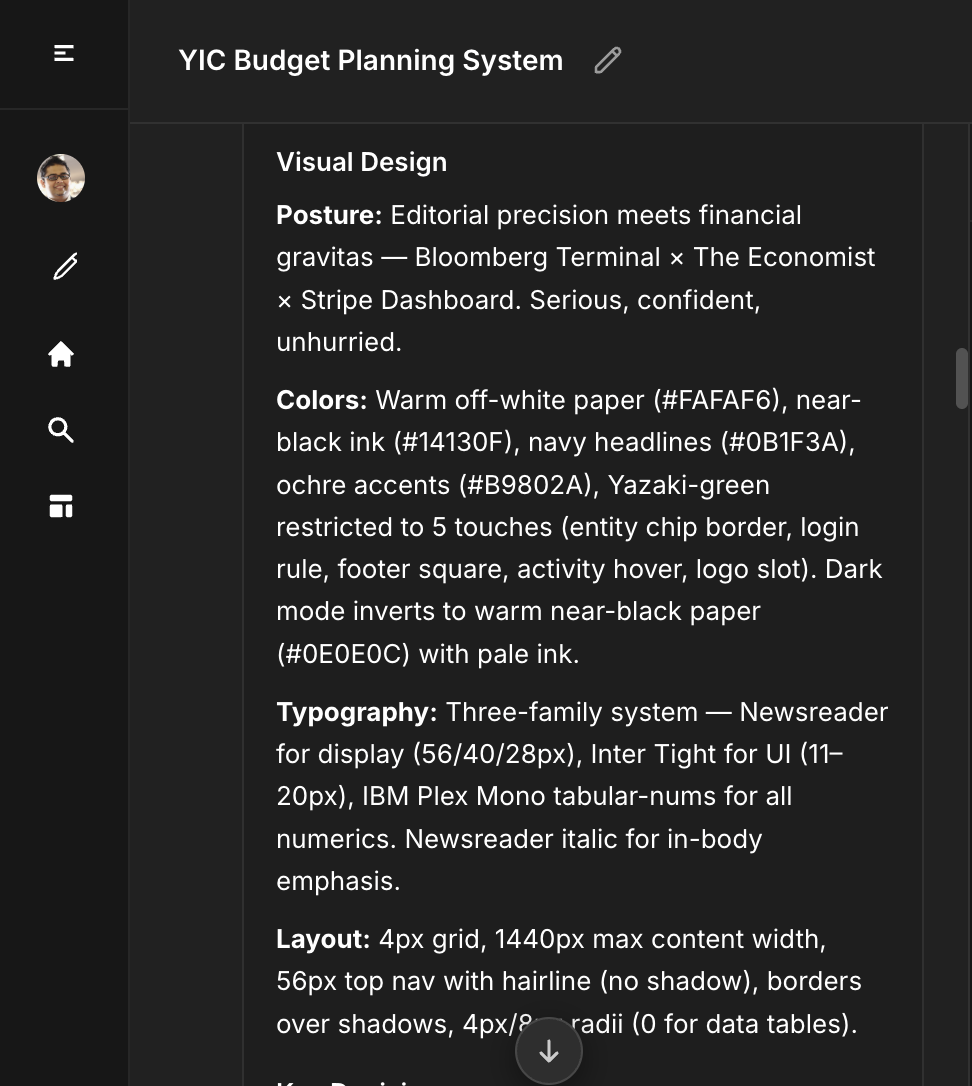
--paper #FAFAF6 · Newsreader
04DATA MODEL
The nouns of the system.
Organization · BudgetVersion
05PAGES & FLOWS
Routes, and what each screen shows.
/variance/overview → op vs FX
06FORBIDDEN
Anti-patterns. What makes it wrong.
"No purple gradients. No emoji."
requirements.md
1,592 lines
The full YIC spec — what the demo app was built from.
Seven questions produce the brief. This produces the build order. MonstarX tooling bridges the two.
WHAT HAPPENS WHEN YOU DROP IT IN
Drop the brief. Get the build.
Drag your requirements.md into MonstarX. AI expands it into a structured build brief — ready for the engineers, human or agent.
INPUT → OUTPUT
minutes, not weeks
.md
requirements.md
your one-page brief
→
mX
MonstarX AI
expands, structures, validates
→
A structured build brief
six sections, ready to hand off
THEN IT JUST… BUILDS.
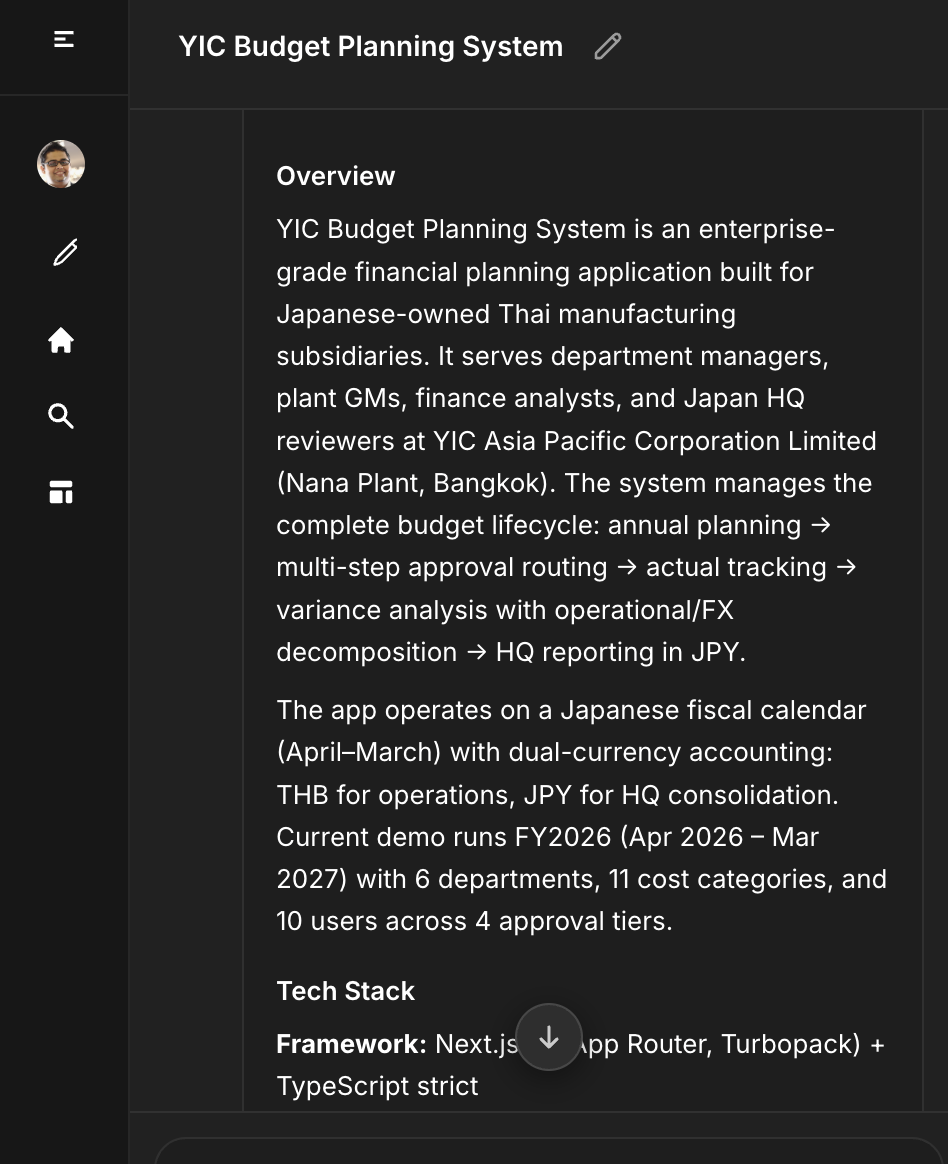
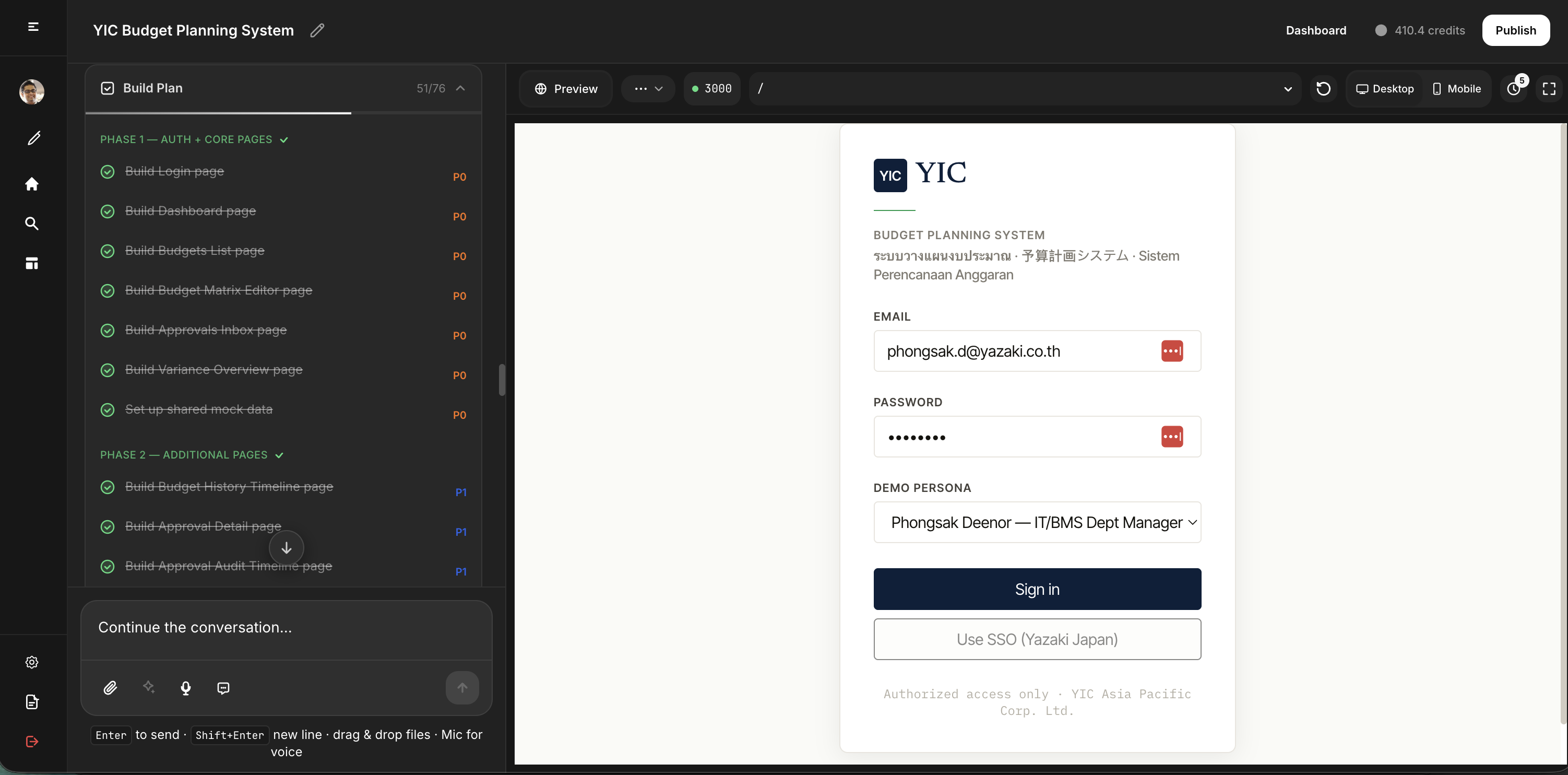
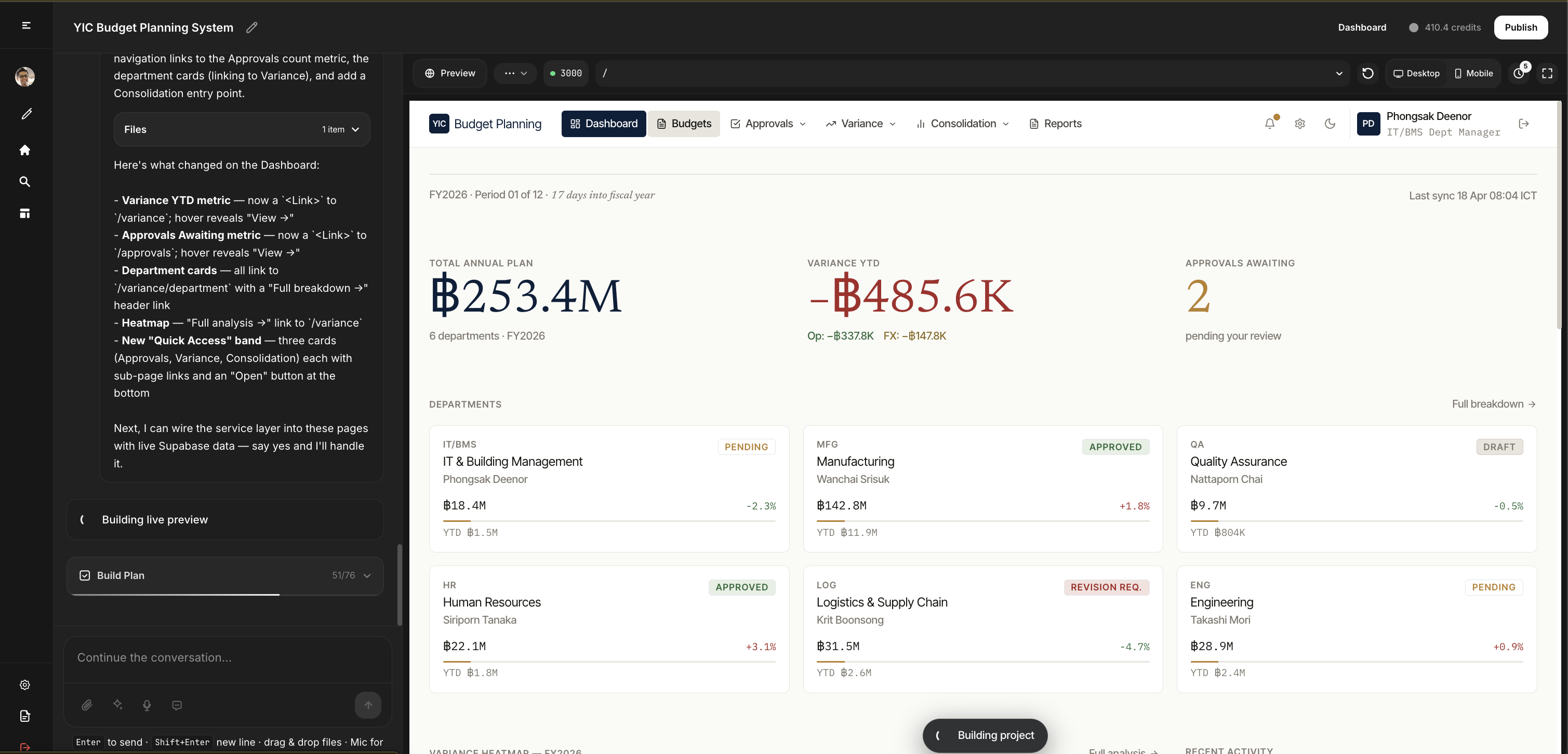
A phase-by-phase build plan. Executed in the browser.
MonstarX turns the structured brief into a sequenced build plan — pages, flows, data, integrations — and runs it live. No IDE. No local setup. No terminal.
LIVE IN BROWSER
zero technical knowledge
monstarx.com/build · YIC Budget Planning System
51 / 76 tasks
WHAT IF THE REQUIREMENT ISN'T WRITTEN DOWN?
No brief. Only code.
Every enterprise has one — a system that still runs the business, but no one can tell you what it does, how it works, or what it would take to change. The docs are gone. The vendor moved on. The person who built it left three years ago. All that remains is the code.
THE INHERITED CODEBASE
a map, not a rewrite
"What does it actually do?"
Nobody here remembers.
"What's the security posture?"
Nobody knows.
"What would it take to modernize?"
Nobody can tell you.
OUR ANSWER
moncode.ai
from the MonstarX team
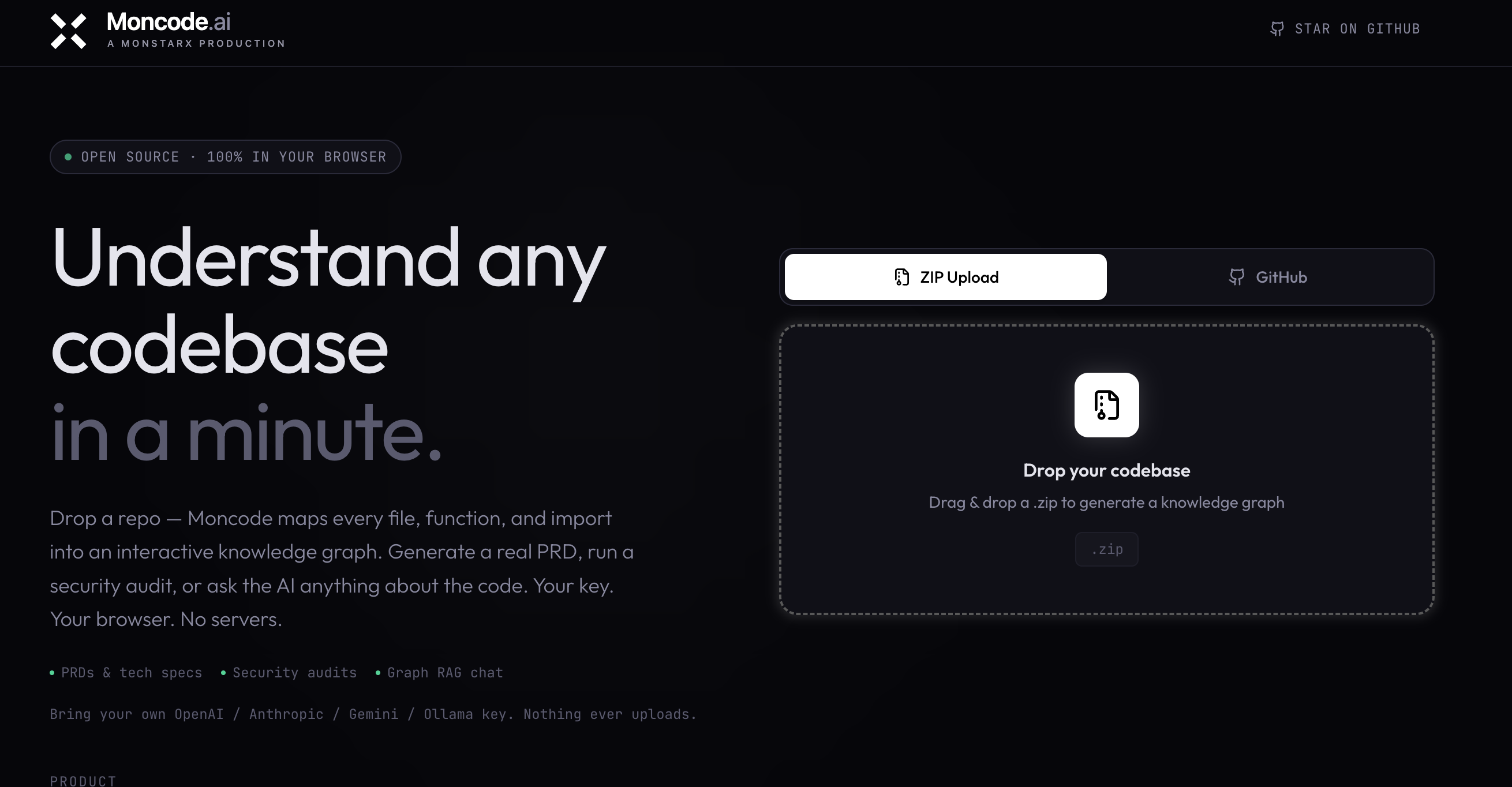
Drop the repo. Get the map.
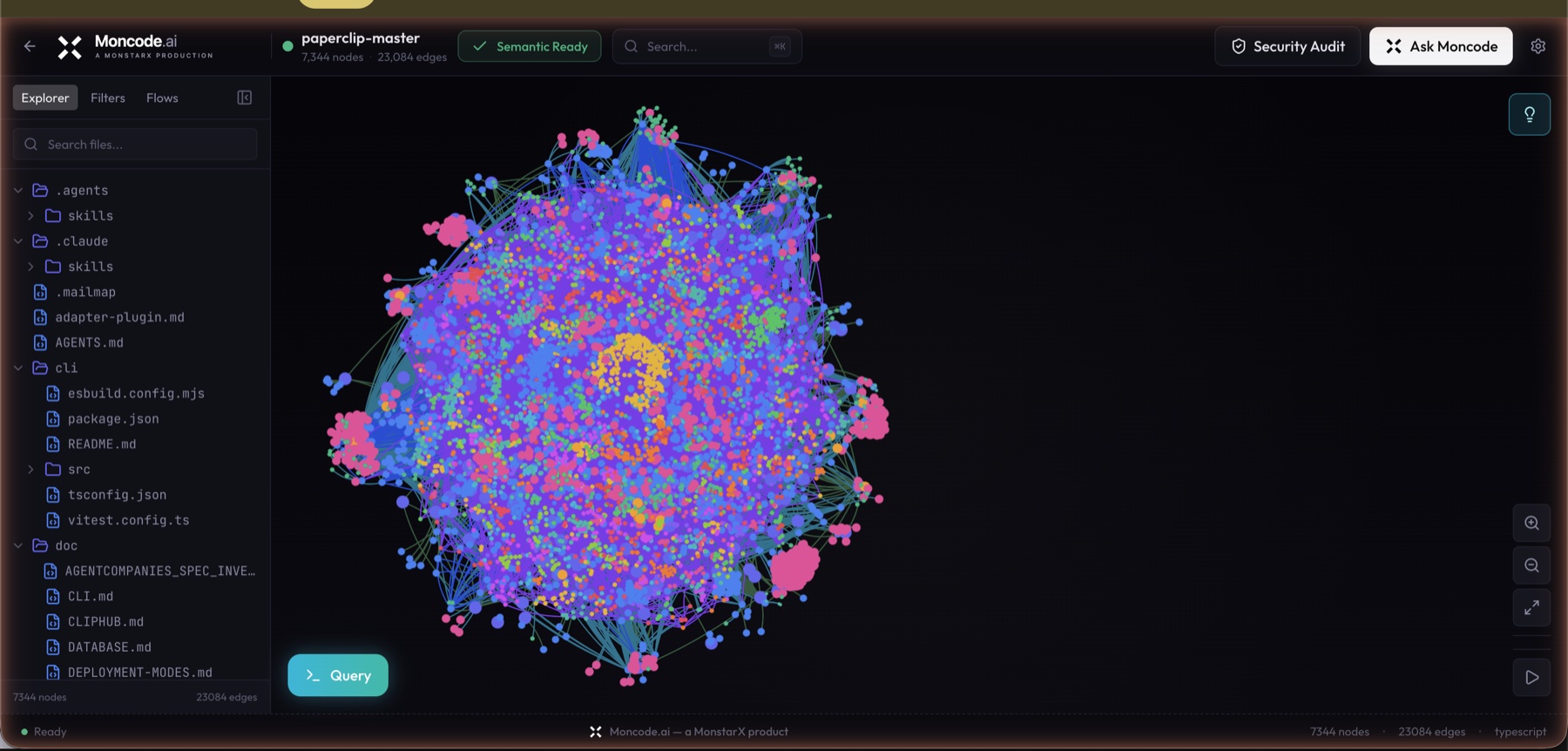
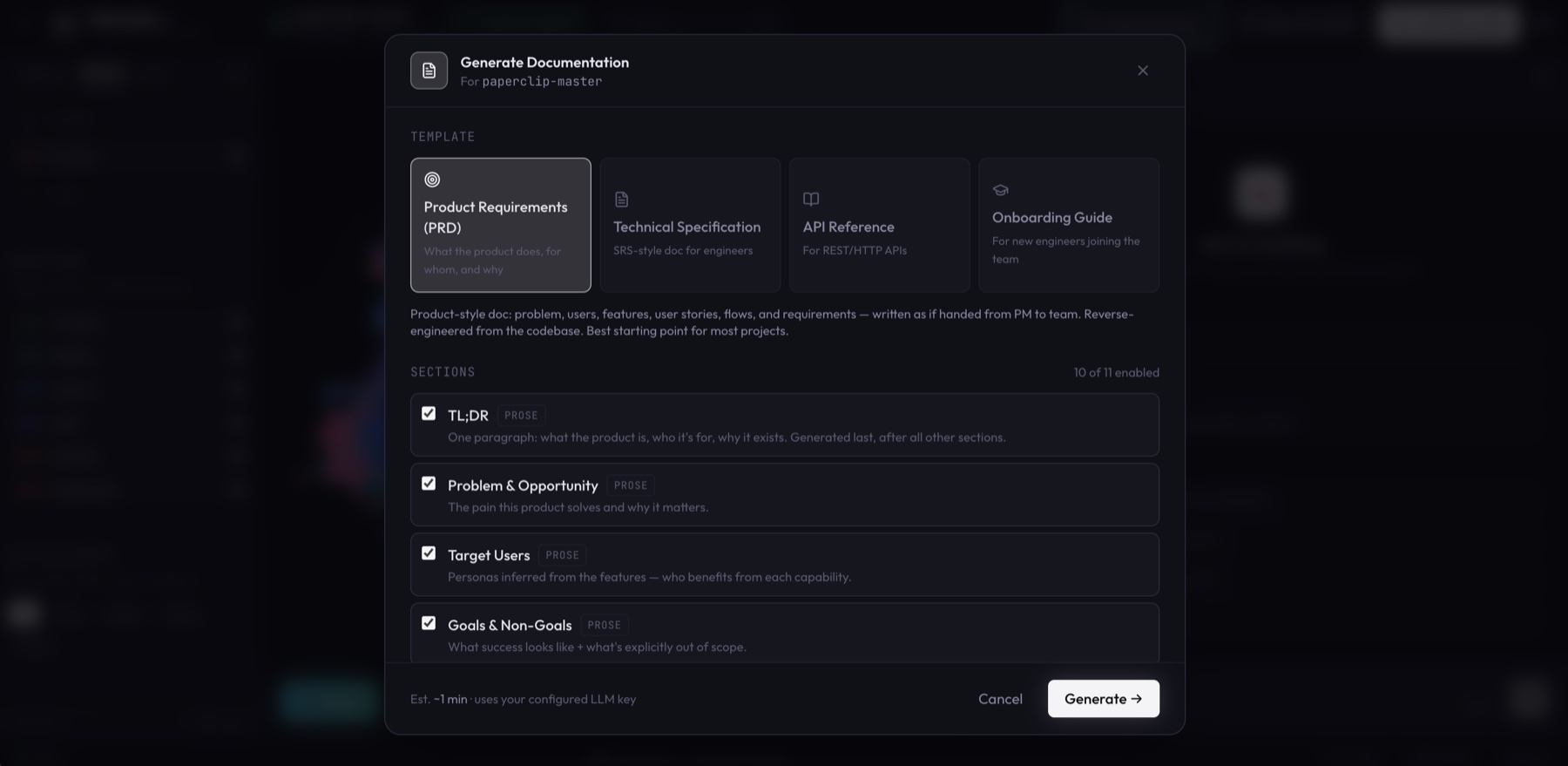
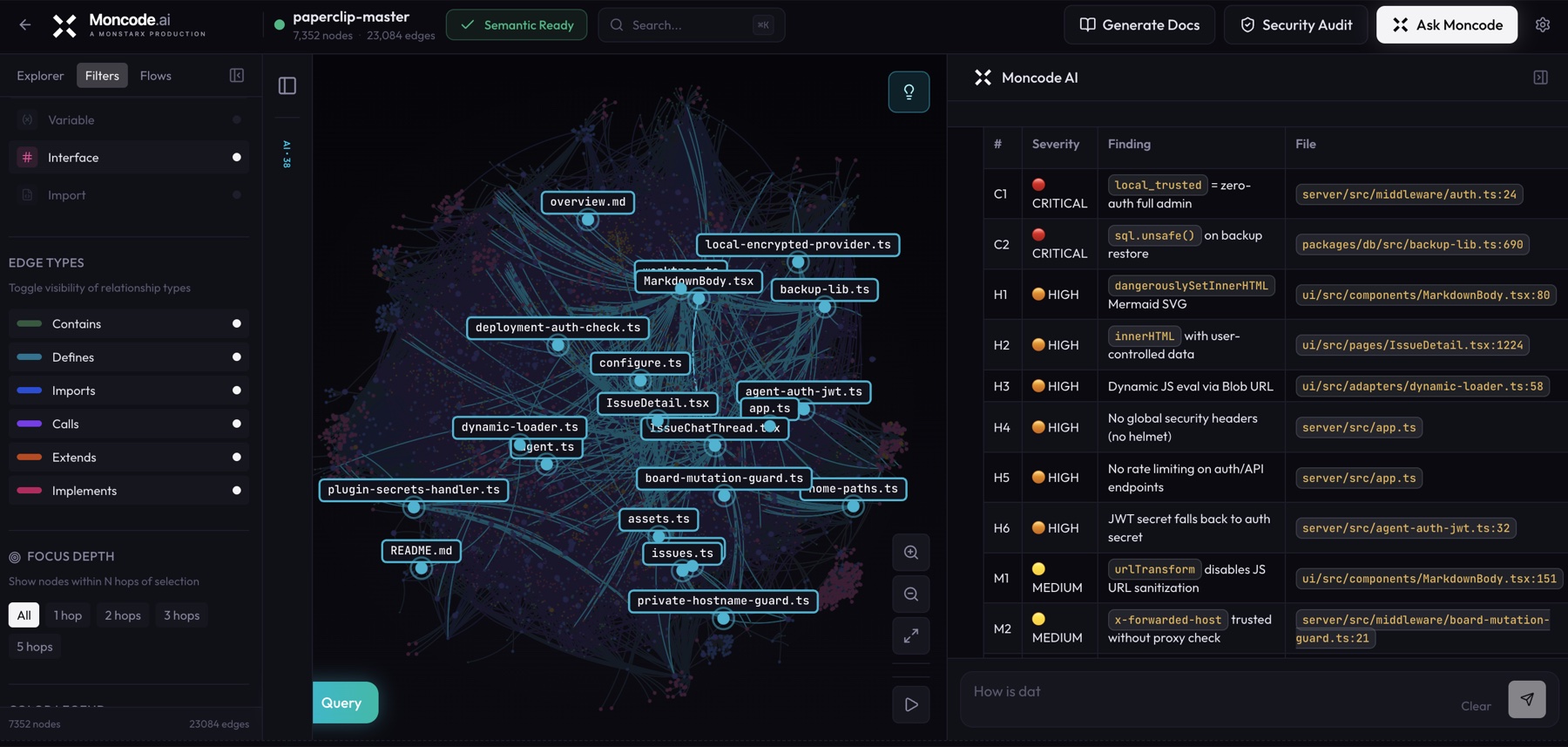
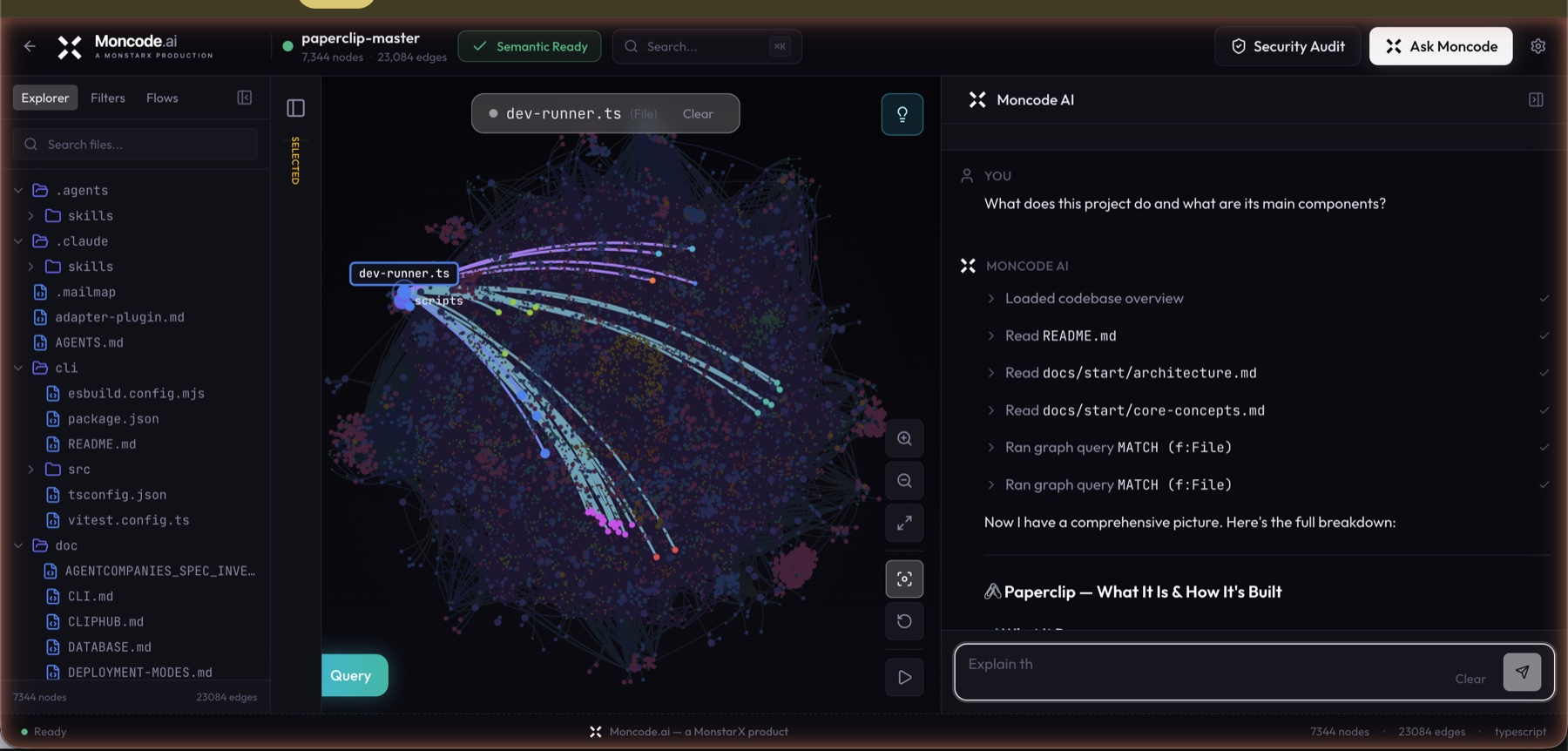
One zip file — or a public GitHub URL — in. Out: a knowledge graph of every file and function, an auto-generated PRD, a security audit, and an AI agent that actually knows the code.
KNOWLEDGE GRAPH
AUTO PRD
SECURITY AUDIT
SEQUENCE DIAGRAMS
AI CHAT (grounded)
100% local. The proprietary code never leaves the laptop. No uploads. No cloud processing. BYO key (OpenAI, Anthropic, Gemini, Ollama).
"Six tools. One repo. Zero onboarding."
moncode.ai — MonstarX, for code you didn't write.
WHAT WE'LL SHOW YOU NEXT
Three demos, three starting points.
Each one begins where most enterprise engagements actually begin — with a different kind of mess. From no documentation, to a brief no one trusts, to a finished system that still needs to be understood.
THE MENU
pick any. or all three.
I.
DEMO ONE
No brief.
Only code.
We reverse-engineer your existing system into a brief — a knowledge graph, an auto-PRD, and an AI agent that knows the code.
the inherited codebase
II.
DEMO TWO
From brief
to POC.
Drop your requirements. Watch MonstarX structure, expand, and build — live in the browser. No IDE. No setup.
a working proof, in minutes
III.
DEMO THREE
One we
prepared earlier.
A production-quality budget planning application — built this week, ready to walk through. The destination, not the journey.
the cooking-show moment
PART II
A working proof —
YIC Budget Planning.
A real, running application built this week for this meeting. Not a mockup. I guessed your requirements. Correct me as we go.
A CALLBACK · THE SEVEN QUESTIONS
I walked through the seven questions about your budget process.
I guessed the answers. Let's see how close I got.
WHAT THIS IS
An end-to-end budget planning tool — with the accounting rule that matters.
Plan, submit, approve, consolidate, and analyze — designed for a Japanese-owned Thai subsidiary. THB spend, JPY reporting, an FY that runs April to March. Variance broken into operational and FX so the Thai team's work is separable from treasury noise.
WHO IT'S FOR
Five people, one chain of approval.
The demo is built around these five. Phongsak is the default persona; you can switch at the top-right of any page to walk the flow in someone else's shoes.
PD
Phongsak Deenor
Dept Manager · IT/BMS
Plans and submits the IT/BMS budget. His name is baked into the demo — audit trails, activity feed, approvals inbox.
SK
Somchai Kittitanakul
Section Manager · Harness
First reviewer in the approval chain. Reviews line-by-line before routing up.
SS
Saegusa Shoji
General Manager · 工場長
Plant-level approver. Returns budgets with notes that show up in the audit trail as prose.
SA
Suwatchai Apiwatana
Finance Analyst · D-FIN
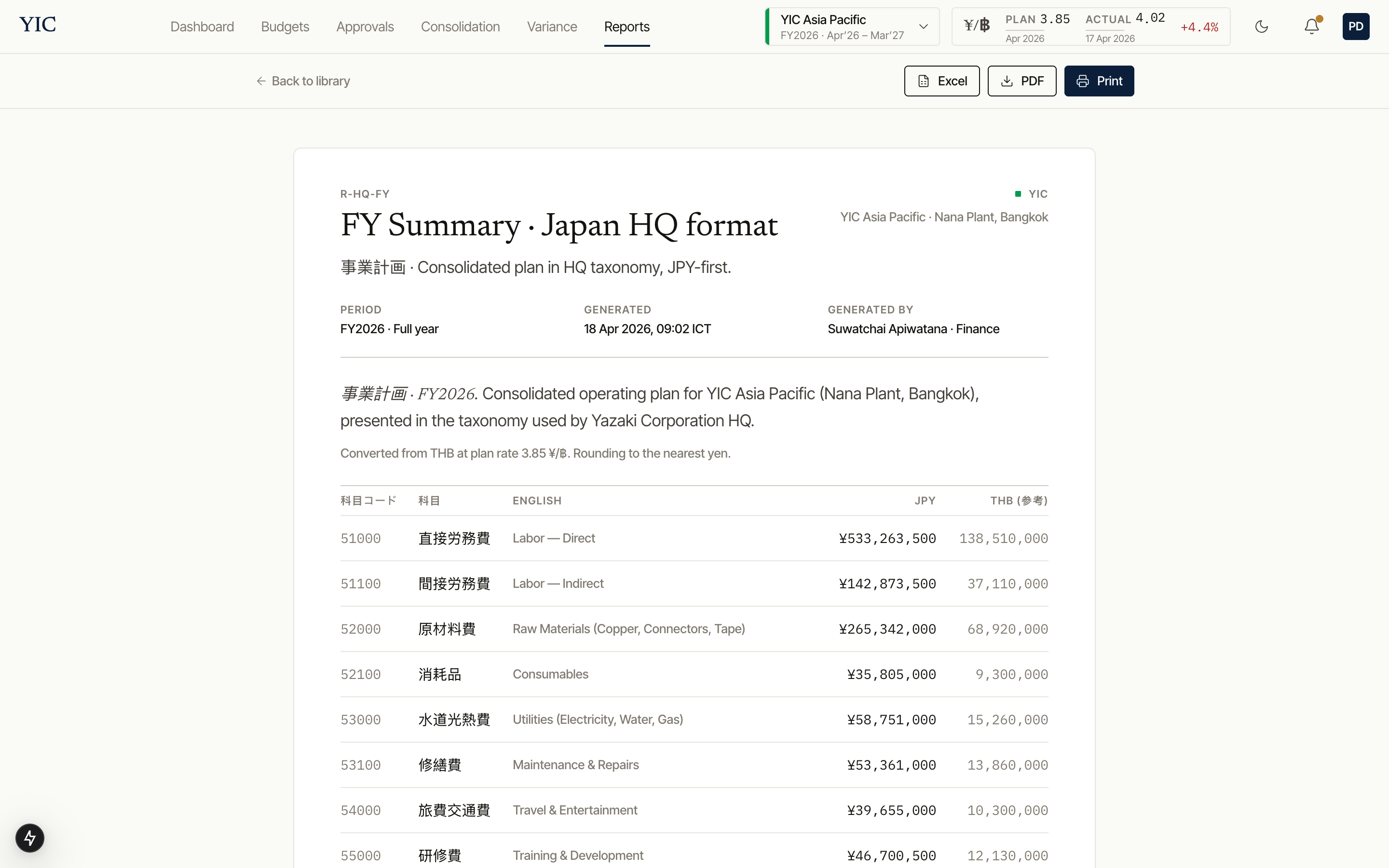
Sets FX rates, runs the 5 standing reports, publishes to HQ.
TH
Tanaka Hiroshi
HQ Reviewer · 本社
Japan HQ controller. Appears in the chain only when budgets exceed THB 50M.
OUR ASSUMPTIONS
Here's what we guessed.
Every one of these is a hypothesis. The workshop is where you correct them. If we guessed wrong, the tool accommodates — nothing is hard-coded except the identity of variance.
Org shape
One plant (Nana, Bangkok), 6 departments under a plant GM. Section managers route up to dept managers, then GM, then HQ over threshold.
Fiscal cadence
April to March. Period 01 = April. Quarterly forecast re-plans (Q1 = July).
HQ threshold
Budgets above THB 50M trigger an HQ Reviewer step. D-MFG-HAR and D-ENG cross it.
Currencies
Local THB spend, JPY reporting to HQ. Plan rate set Feb 15, revised at Q1. Actual feeds daily.
Variance rule
(actual − plan) × plan_rate = operational. actual × (actual_rate − plan_rate) = FX. Identity verified in app.
Demo moment
Current state is FY2026 P01, 17 days in. In-flight: 3 approvals on Phongsak's desk, 2 approved by Saegusa.
PART II · CONTINUED
Let's walk it —
feature by feature.
Every slide that follows shows the actual, running application.
THE DASHBOARD
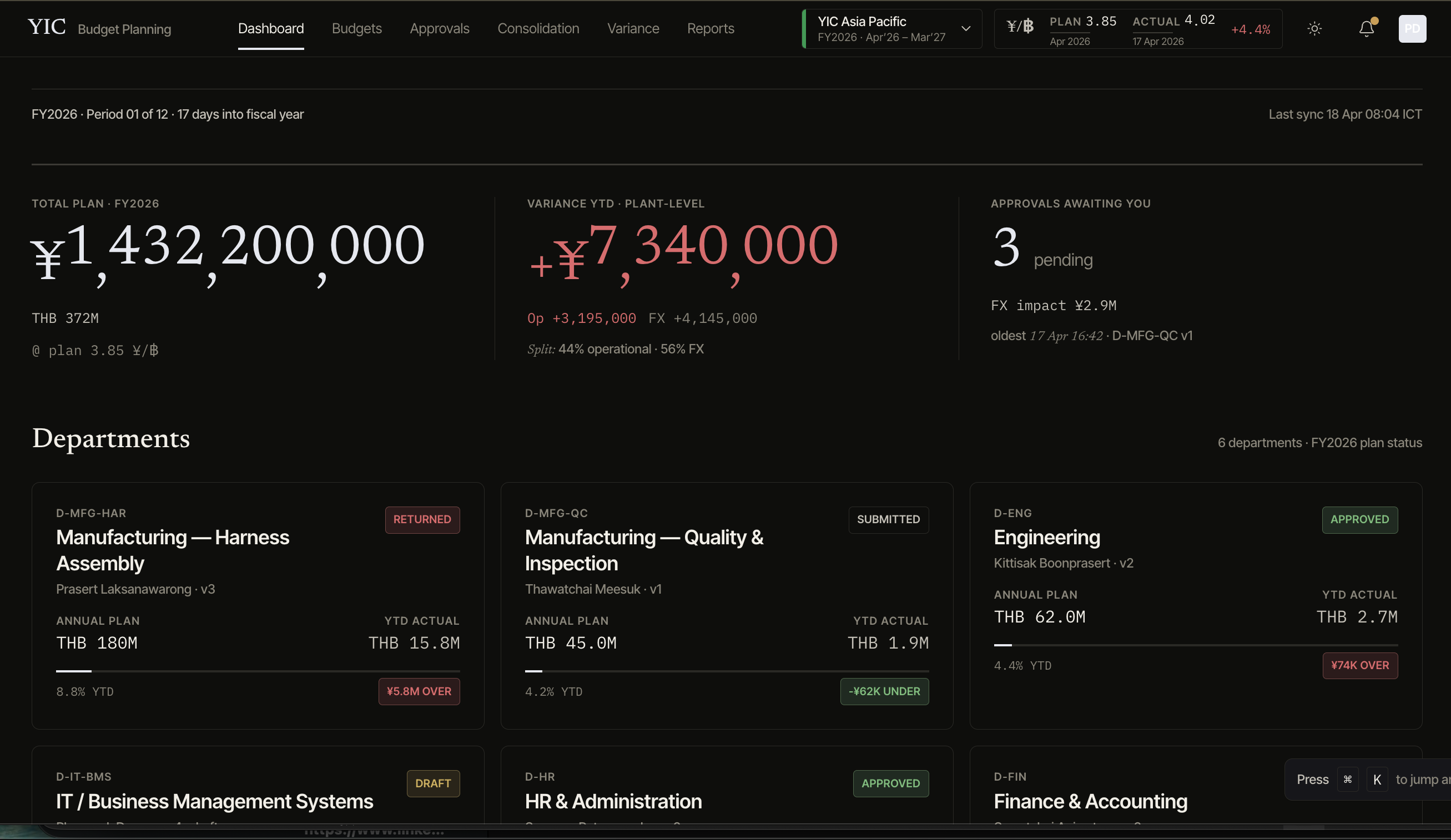
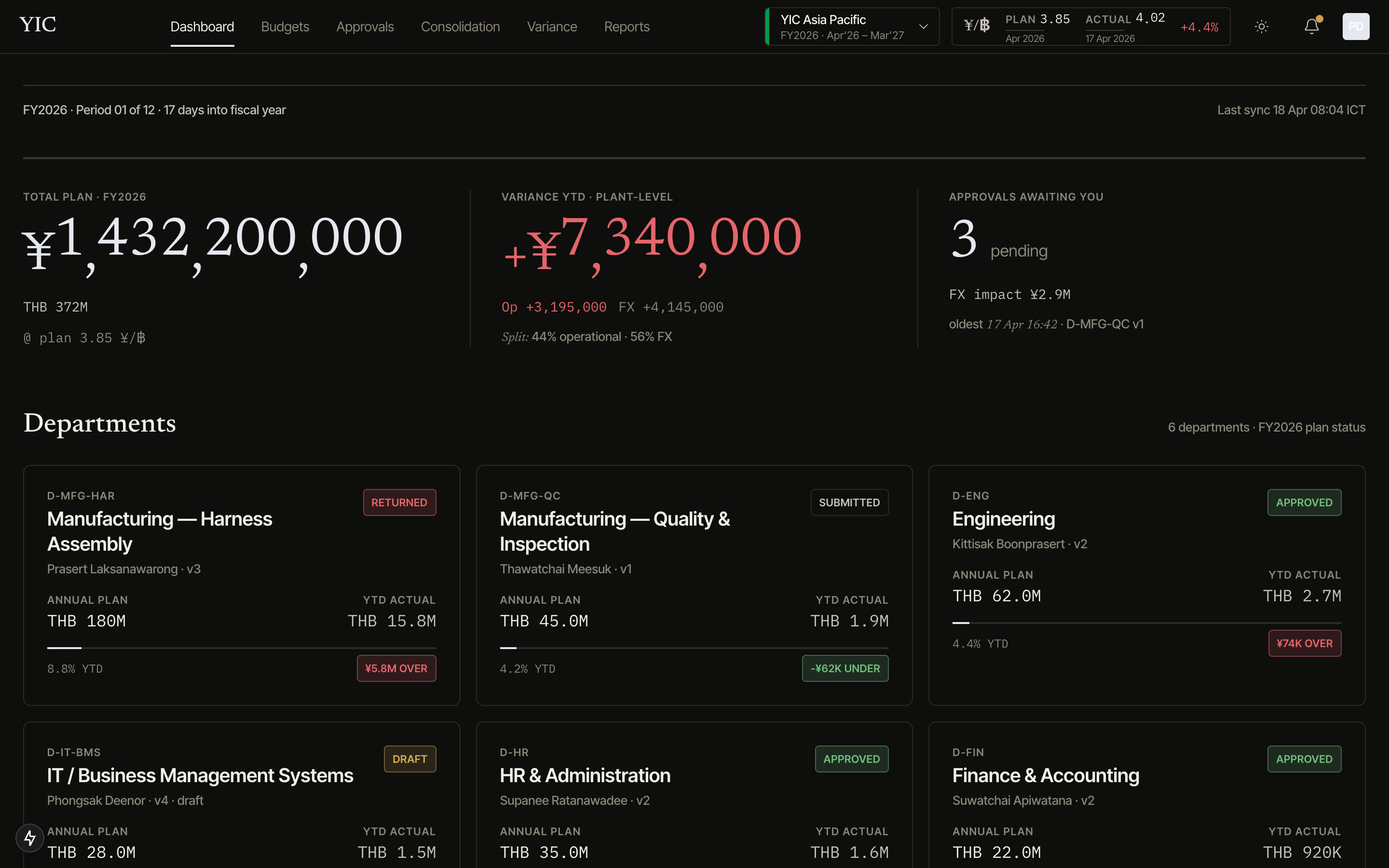
Dense without clutter.
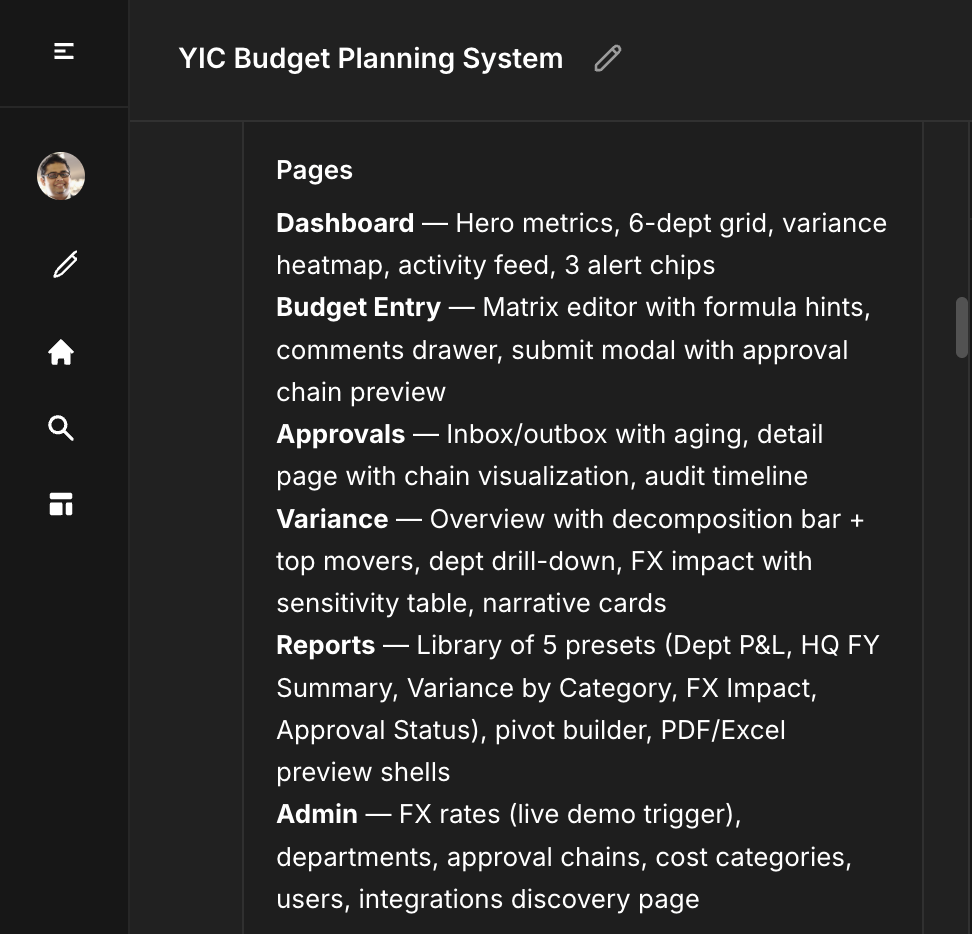
The opening screen is lived-in. No empty states, no "Welcome back." Five bands of information dense enough for a CFO and legible enough for a GM who prefers paper.
- A Fiscal context strip
- B Three hero metrics — Display XL Newsreader
- C Six department cards with YTD + variance
- D 6×12 variance heatmap + live activity feed
- E Alerts needing attention
BUDGET ENTRY · WOW 5 + WOW 6
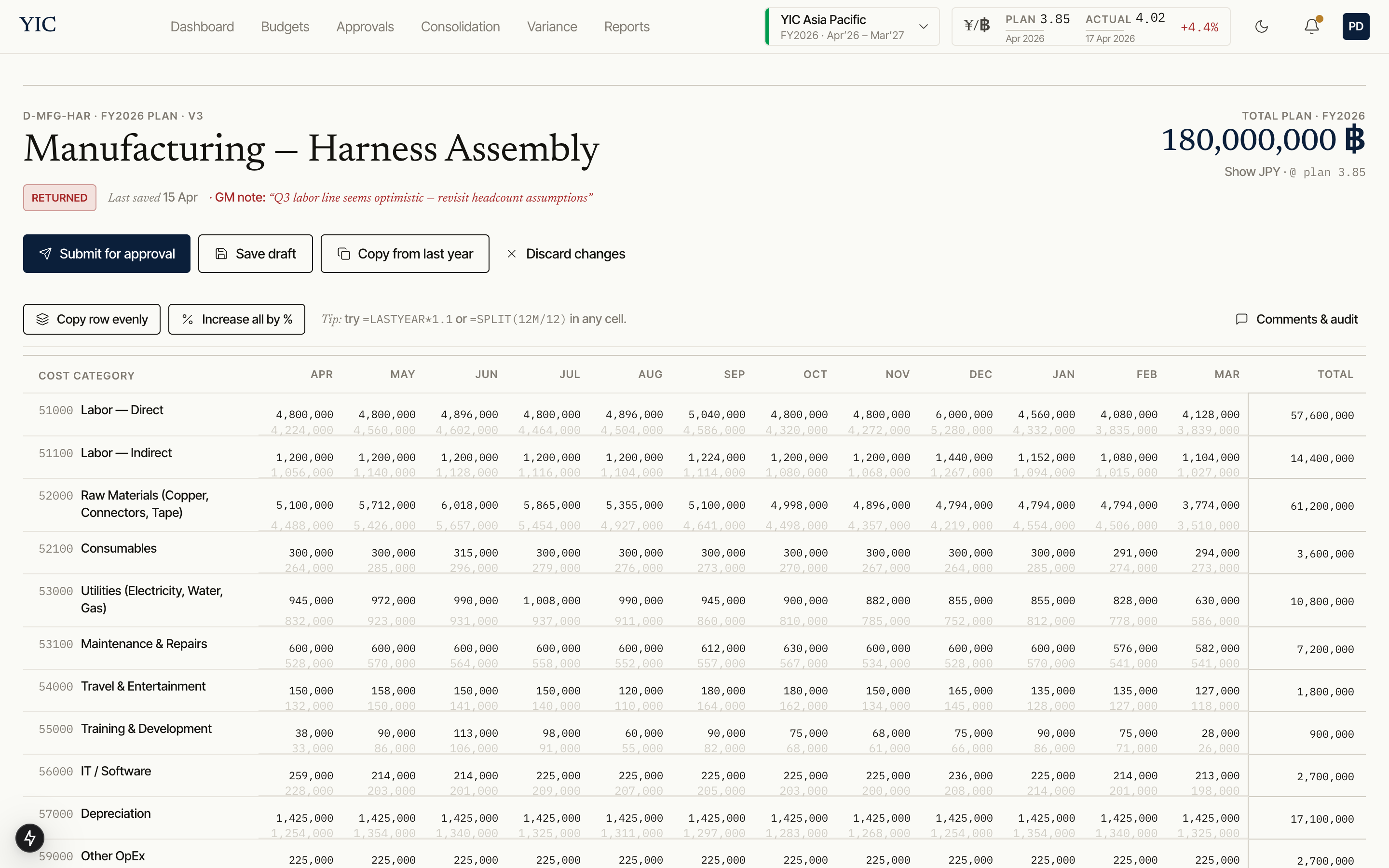
A spreadsheet, inside an enterprise tool.
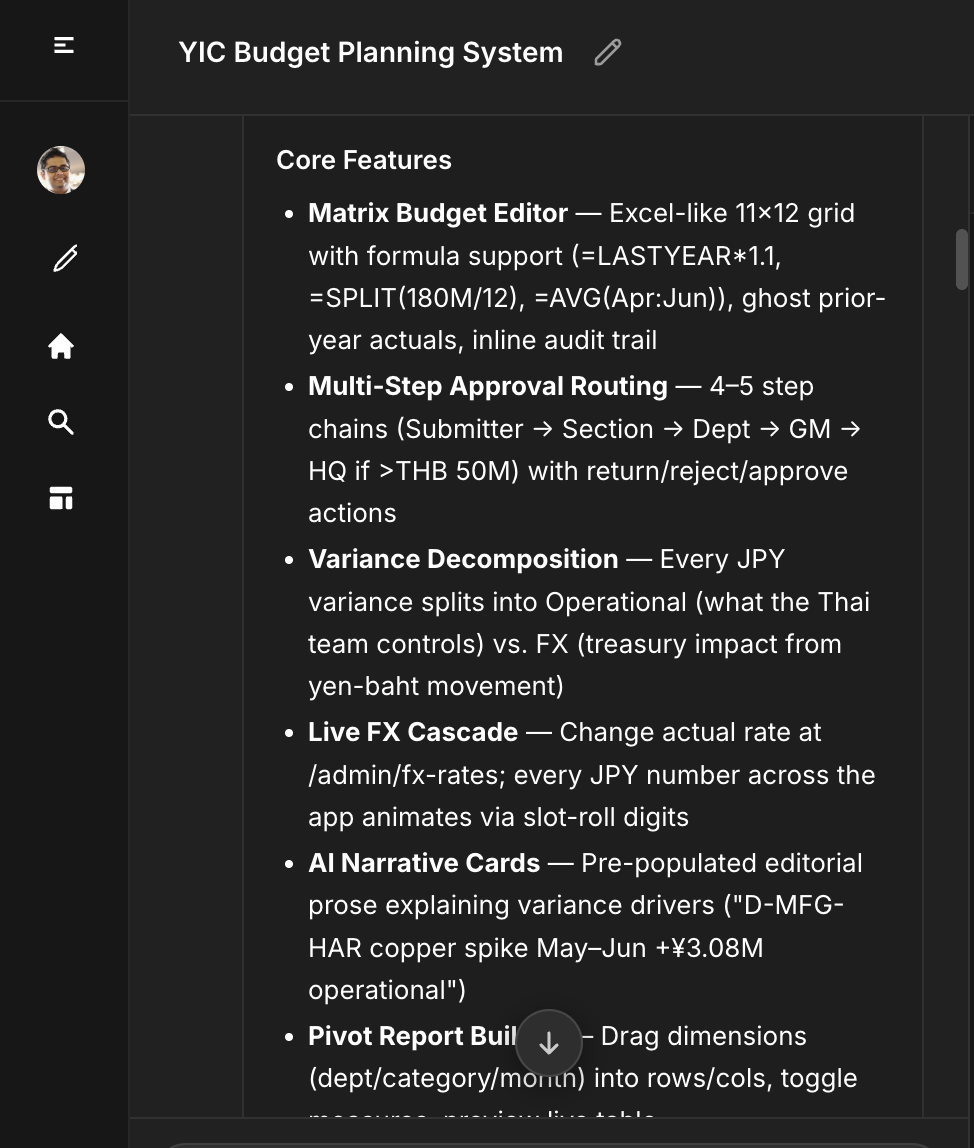
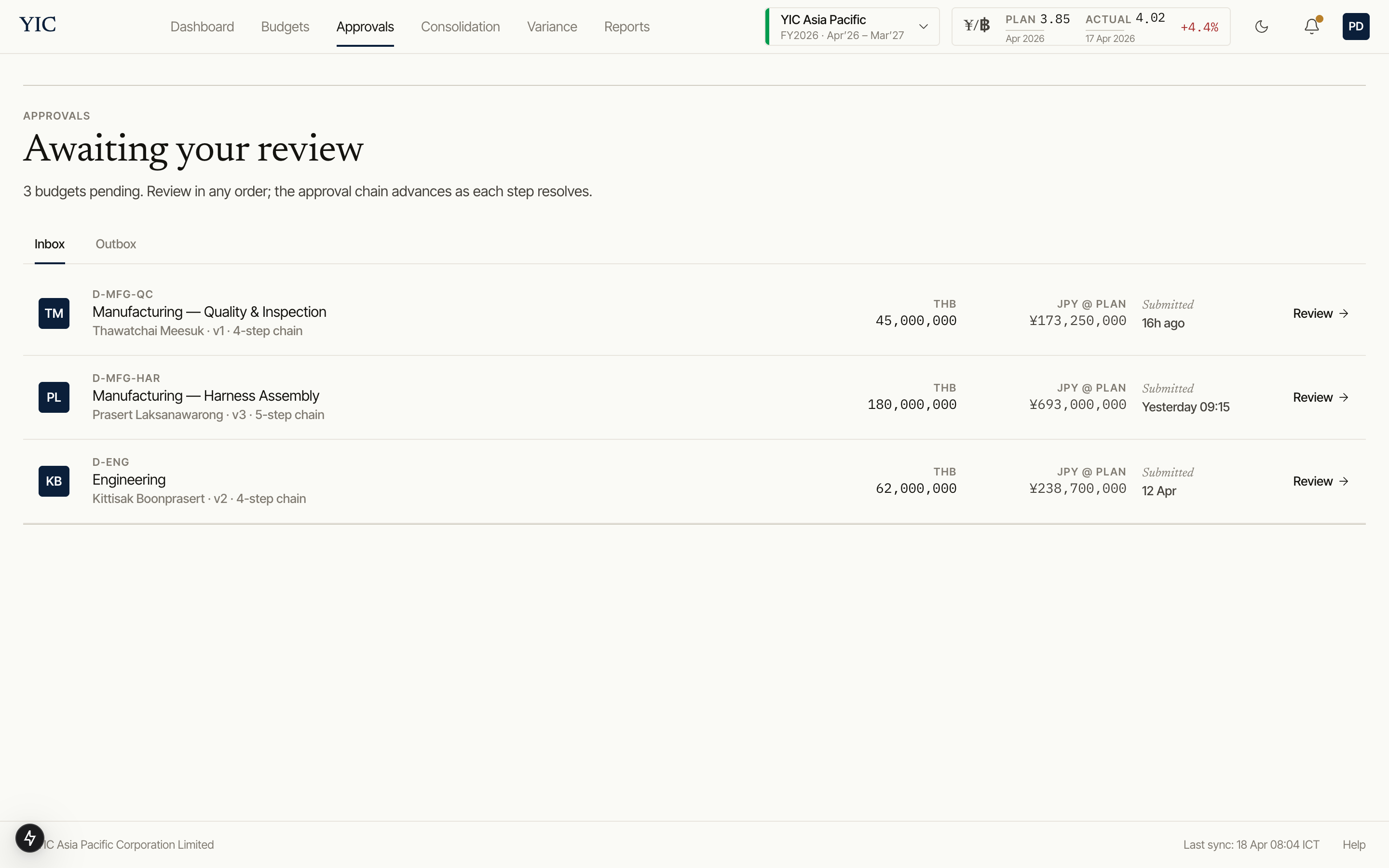
11 cost categories × 12 months. Type =LASTYEAR*1.1 or =SPLIT(180M/12) in any cell. Every cell shows the prior-year actual as a ghost number — finance staff live in spreadsheets; give them spreadsheet muscle memory inside an enterprise tool.
- · Tab / Enter navigate · = starts formula
- · Right-click any cell for quick actions
- · Ghost values update if prior year changes
/budgets/BV-D-MFG-HAR-FY2026-PLAN/edit
APPROVALS
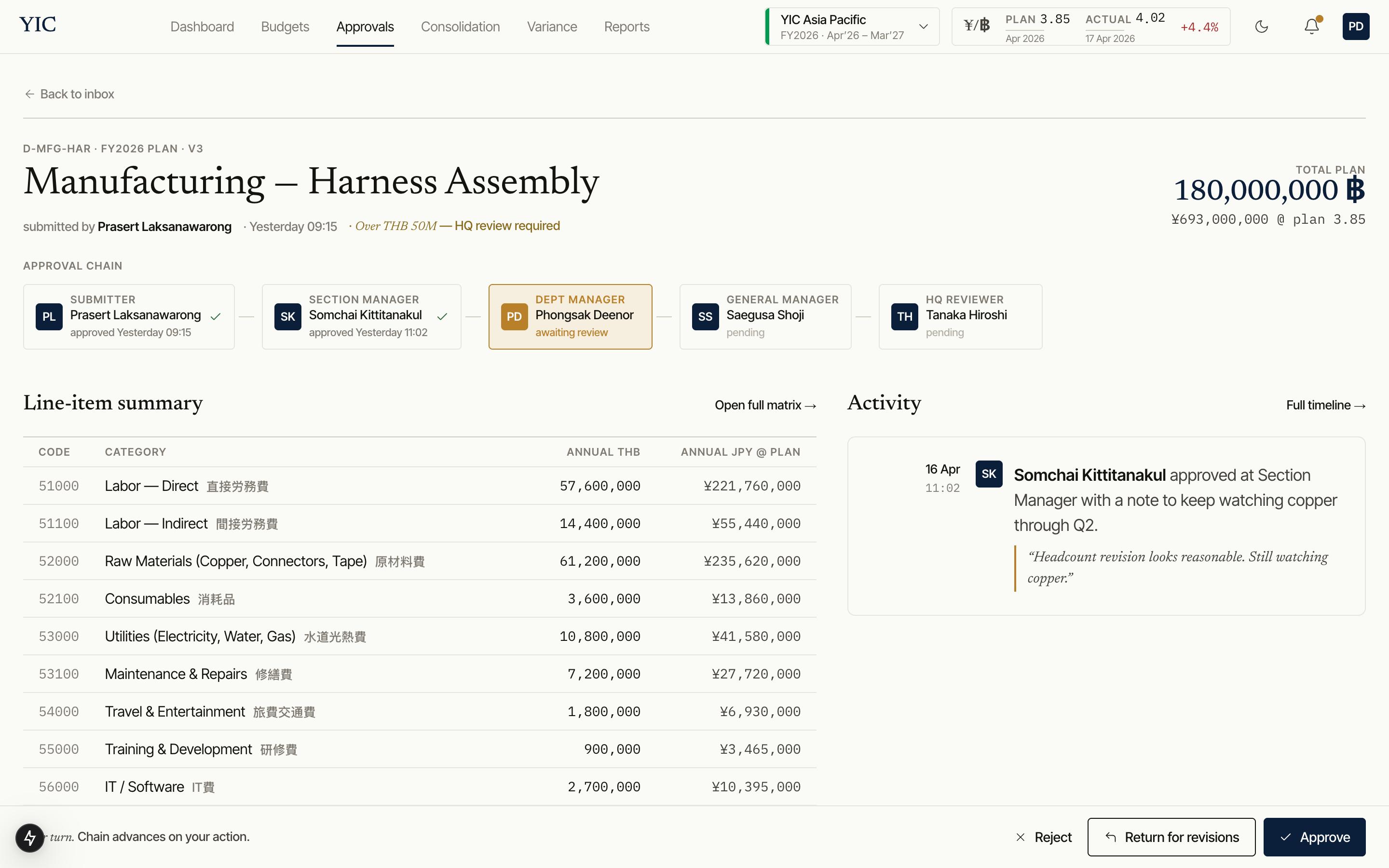
The chain of sign-off, visualized.
Five steps by default; six when the budget crosses THB 50M (HQ reviewer appended). The current step glows ochre. Every action is a comment, every comment becomes an audit entry.
- Approve · routes to the next step
- Return for revisions · sends back with a required reason
- Reject · stops the chain
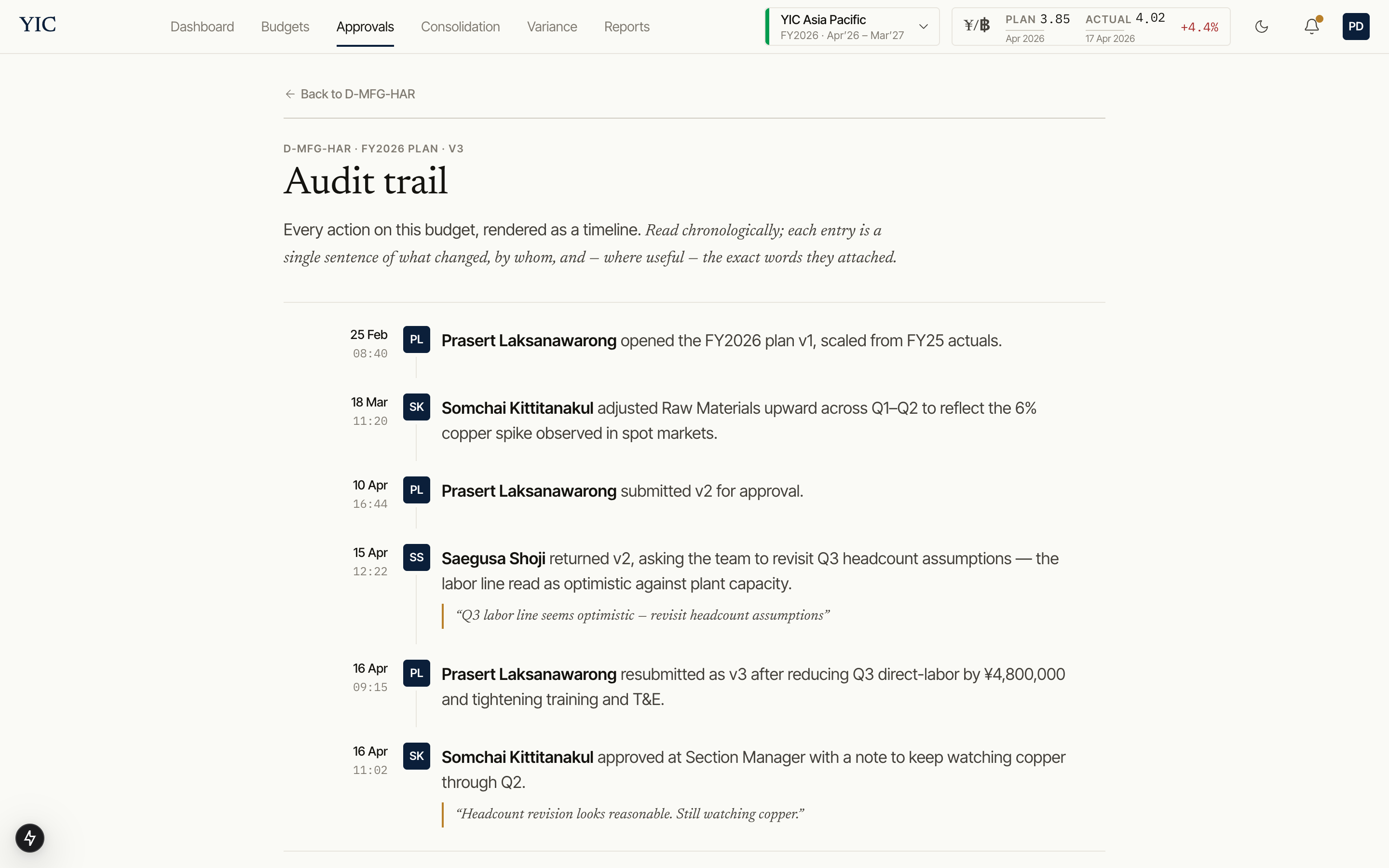
WOW 7 · THE AUDIT TRAIL AS A TIMELINE
Not a log.
A story.
The audit trail renders as an editorial timeline — time labels in a rail, an avatar, a sentence written like an editor wrote it. Quotes render in Newsreader italic with an ochre rule. The microcopy is the feature.
"Saegusa Shoji returned v2, asking the team to revisit Q3 headcount assumptions — the labor line read as optimistic against plant capacity."
/approvals/AR-MFG-HAR/audit
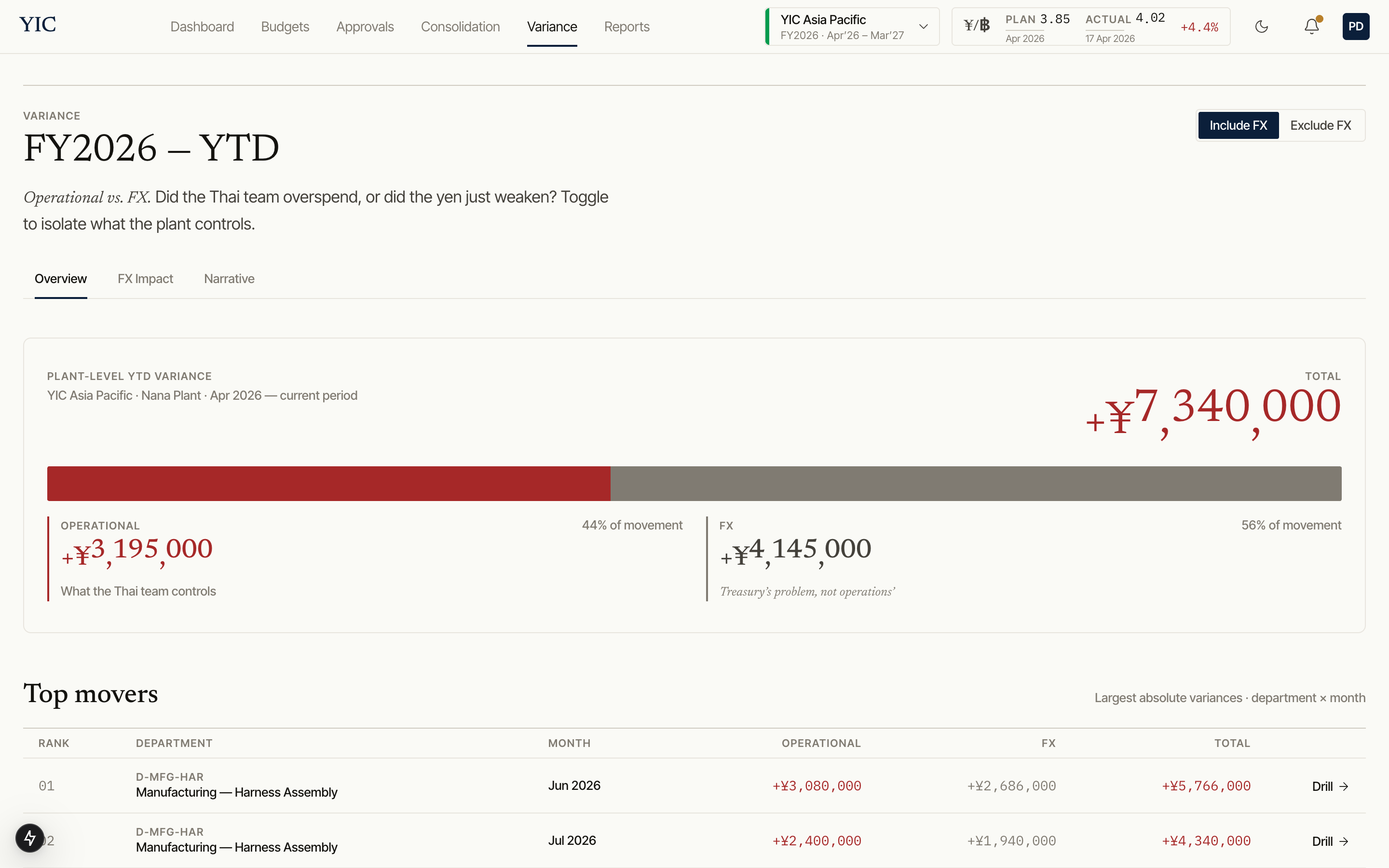
WOW 2 · VARIANCE OVERVIEW
The money shot.
A horizontal stacked bar splits the plant's variance into Operational and FX. One glance answers the question every Japanese GM asks: did the Thai team overspend, or did the yen weaken?
OPERATIONAL · ¥3.08MFX · ¥2.69M
Toggle Exclude FX and the bar becomes 100% operational. Thai team's execution shows cleanly without treasury noise.
WOW 1 · THE CASCADE
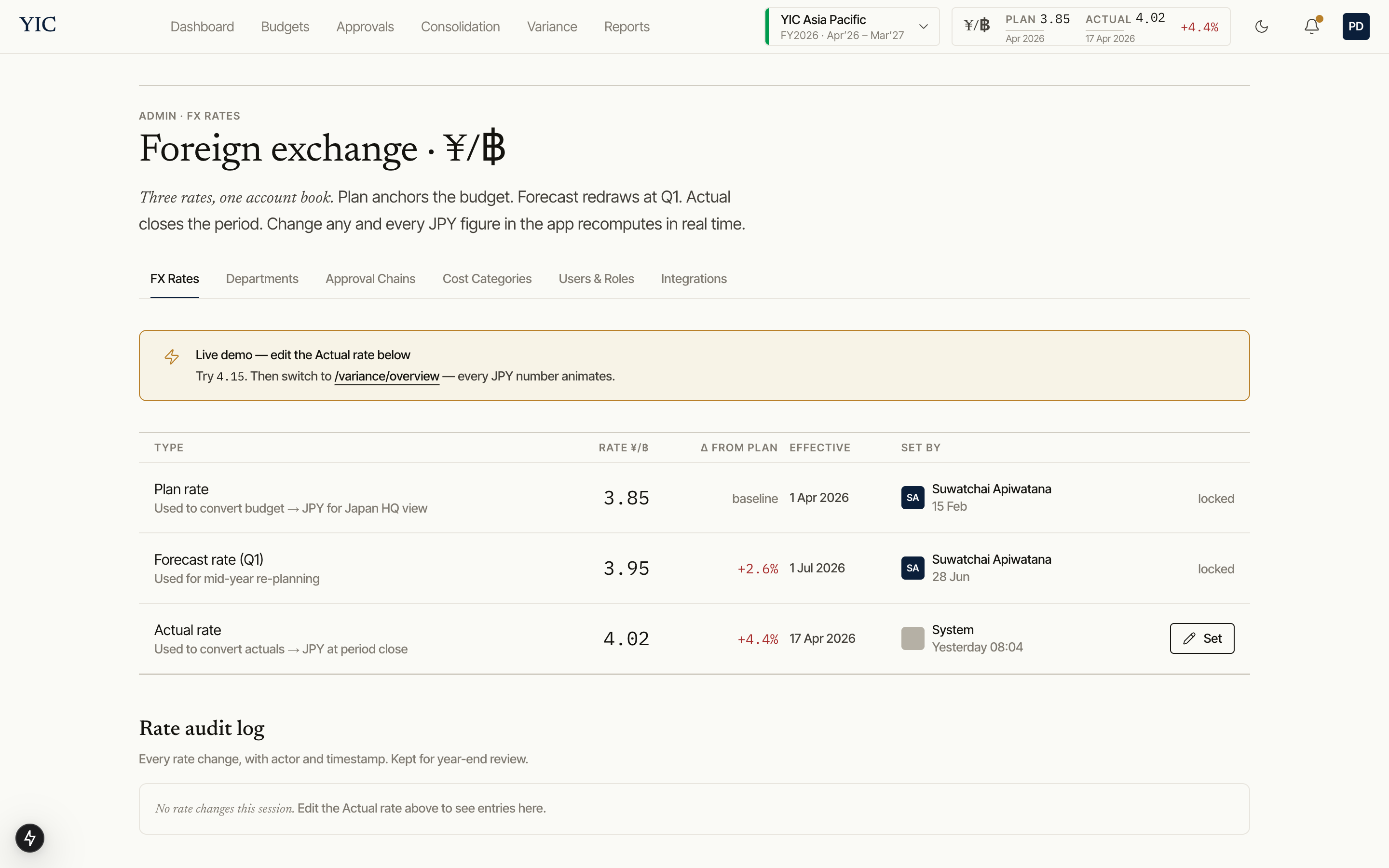
Change one number. Every number updates.
Open /admin/fx-rates, set the Actual rate from 4.02 to 4.15, flip to Variance Overview. Every JPY figure slot-rolls to its new value. Operational variance is unchanged — rate movement is treasury's problem, not operations'.
LIVE IN THE DEMO
Try 4.15 yourself — or run the cascade from /admin/fx-rates.
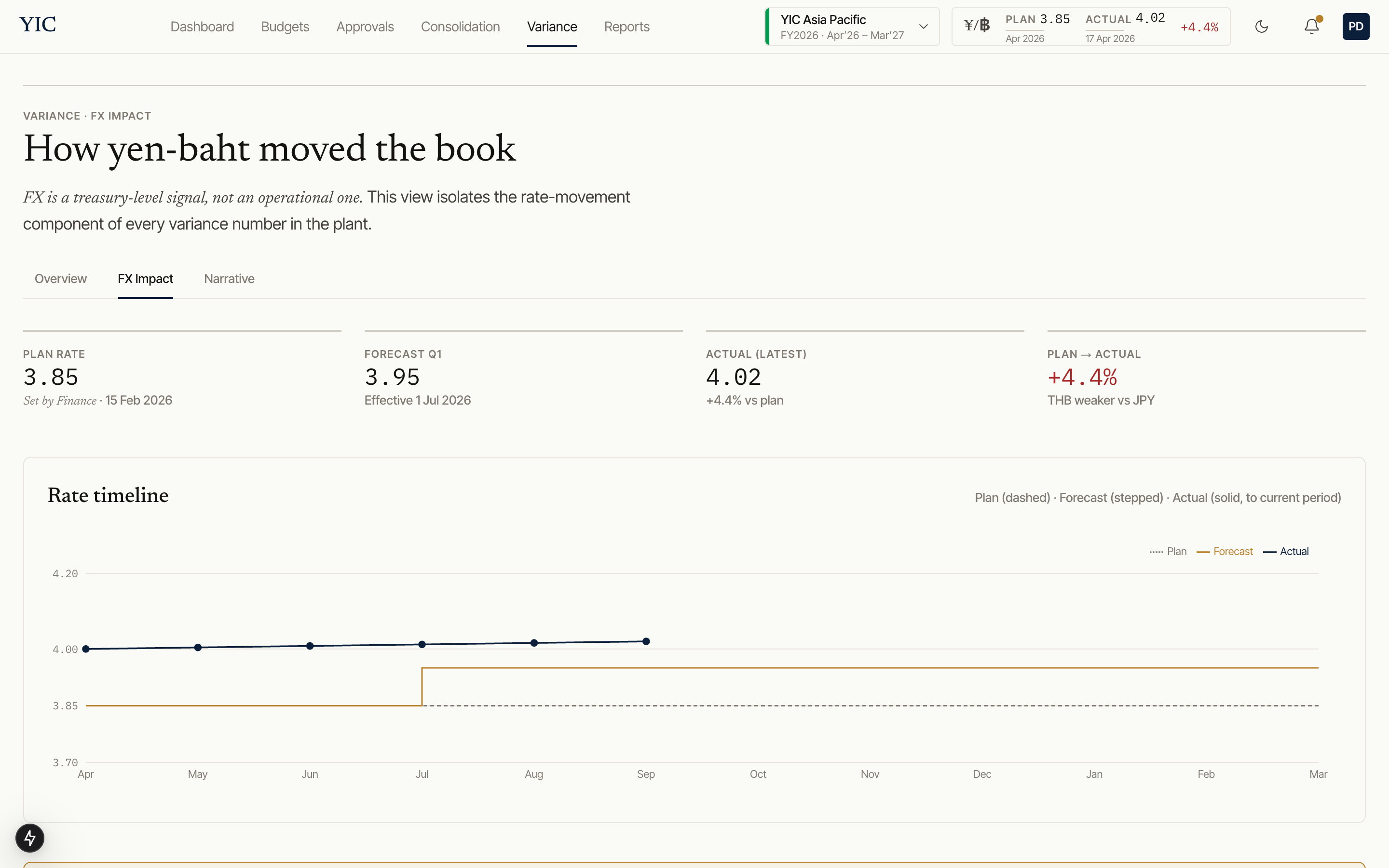
FX IMPACT ANALYSIS
Treasury-level signals, isolated.
The FX rate timeline shows plan (dashed), forecast (stepped), and actual (solid). A sensitivity table quantifies how each department moves per ¥1 weakening of THB — so a hedging conversation starts from concrete numbers.
AI NARRATIVE
Not magic. An augmentation layer.
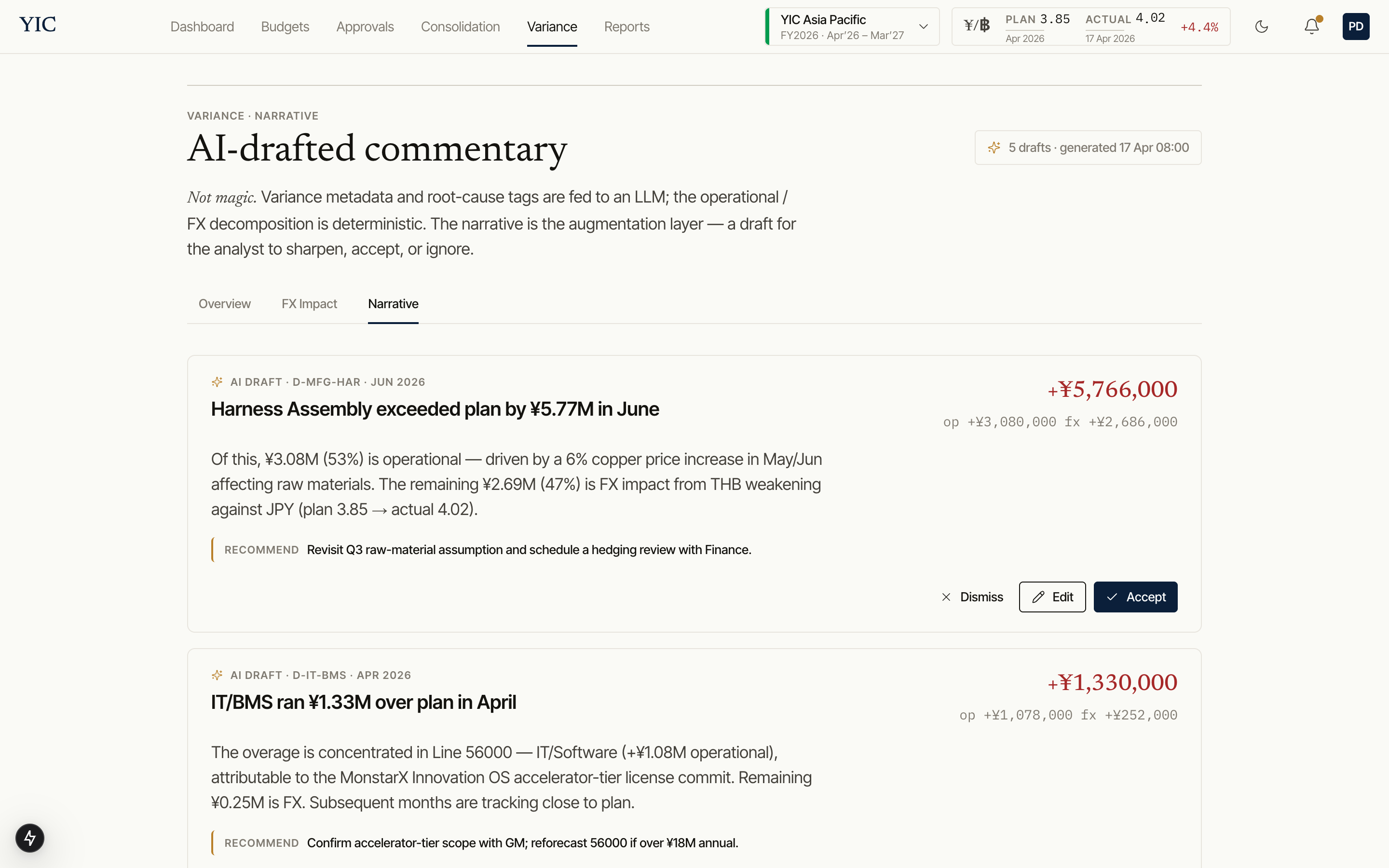
Variance metadata feeds an LLM that drafts commentary in the voice of a finance controller. The operational/FX split is deterministic; the prose is the augmentation. Analyst can accept, edit, or dismiss.
"Harness Assembly exceeded plan by ¥5.77M in June. ¥3.08M (53%) is operational — driven by a 6% copper price spike. The remaining ¥2.69M (47%) is FX."
REPORTS
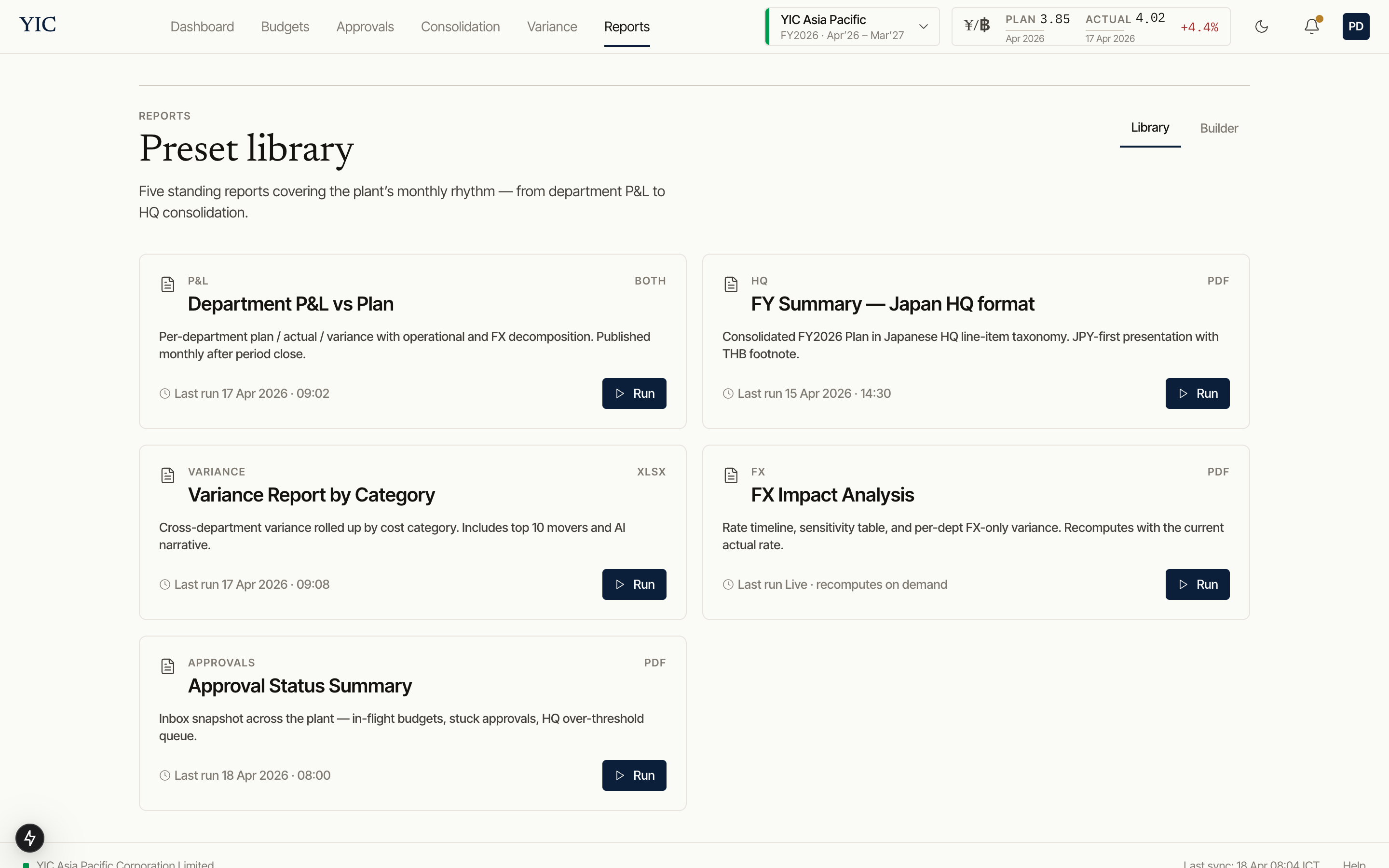
Five standing reports, plus a real pivot builder.
Dept P&L vs Plan · HQ FY Summary (Japanese taxonomy, JPY-first) · Variance by Category · FX Impact · Approval Status. Every number lives — change the FX rate and re-run; the numbers track.
REPORT BUILDER
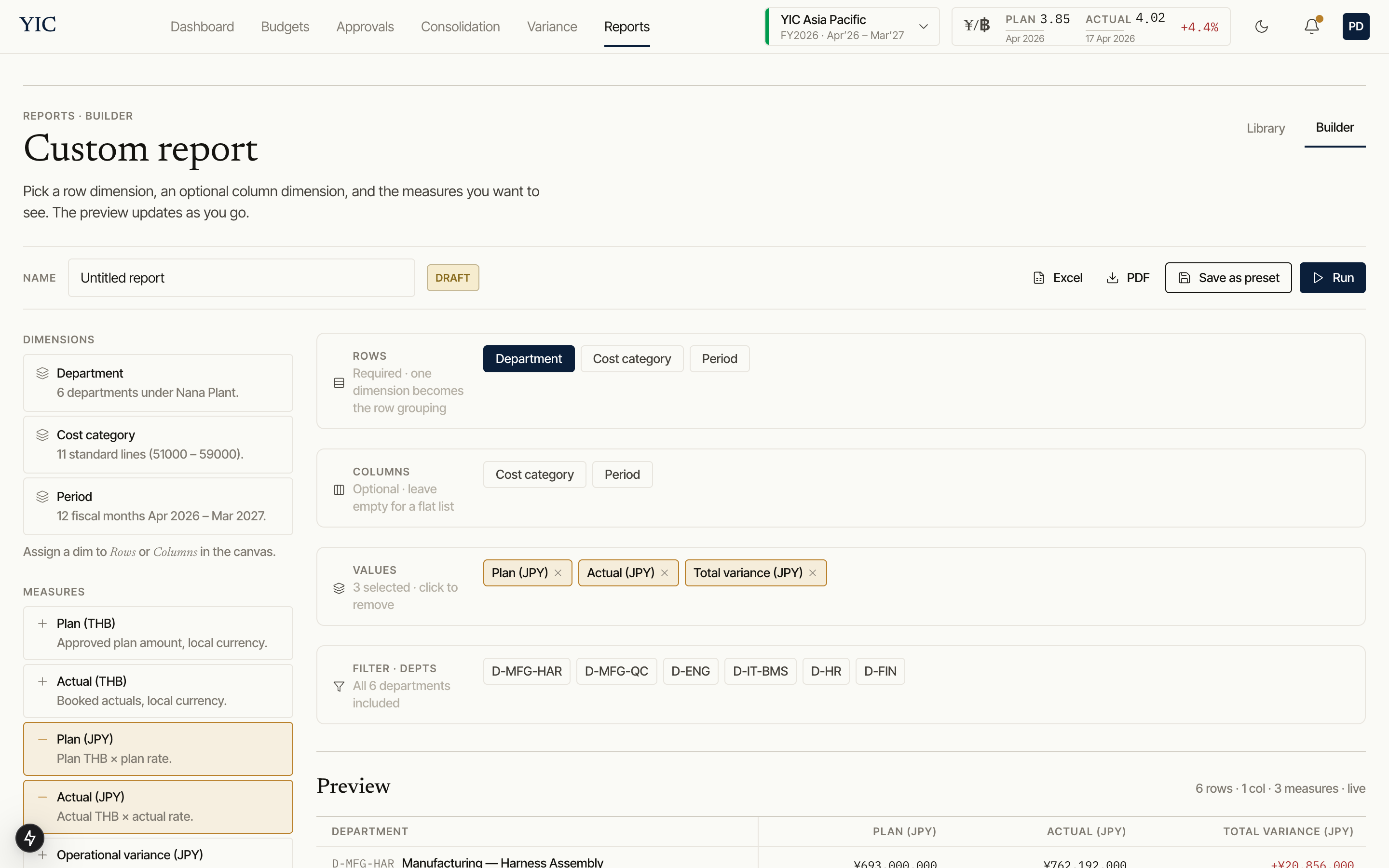
A real pivot.
Not a mockup.
Three dimensions (department, category, period), seven measures, dept-level filters. Row-dim + optional column-dim + any number of measure columns, totals in both axes, live preview.
Click Save as preset and (in production) it lands in the library.
DISCOVERY PROMPT · INTEGRATIONS
Where your systems plug in.
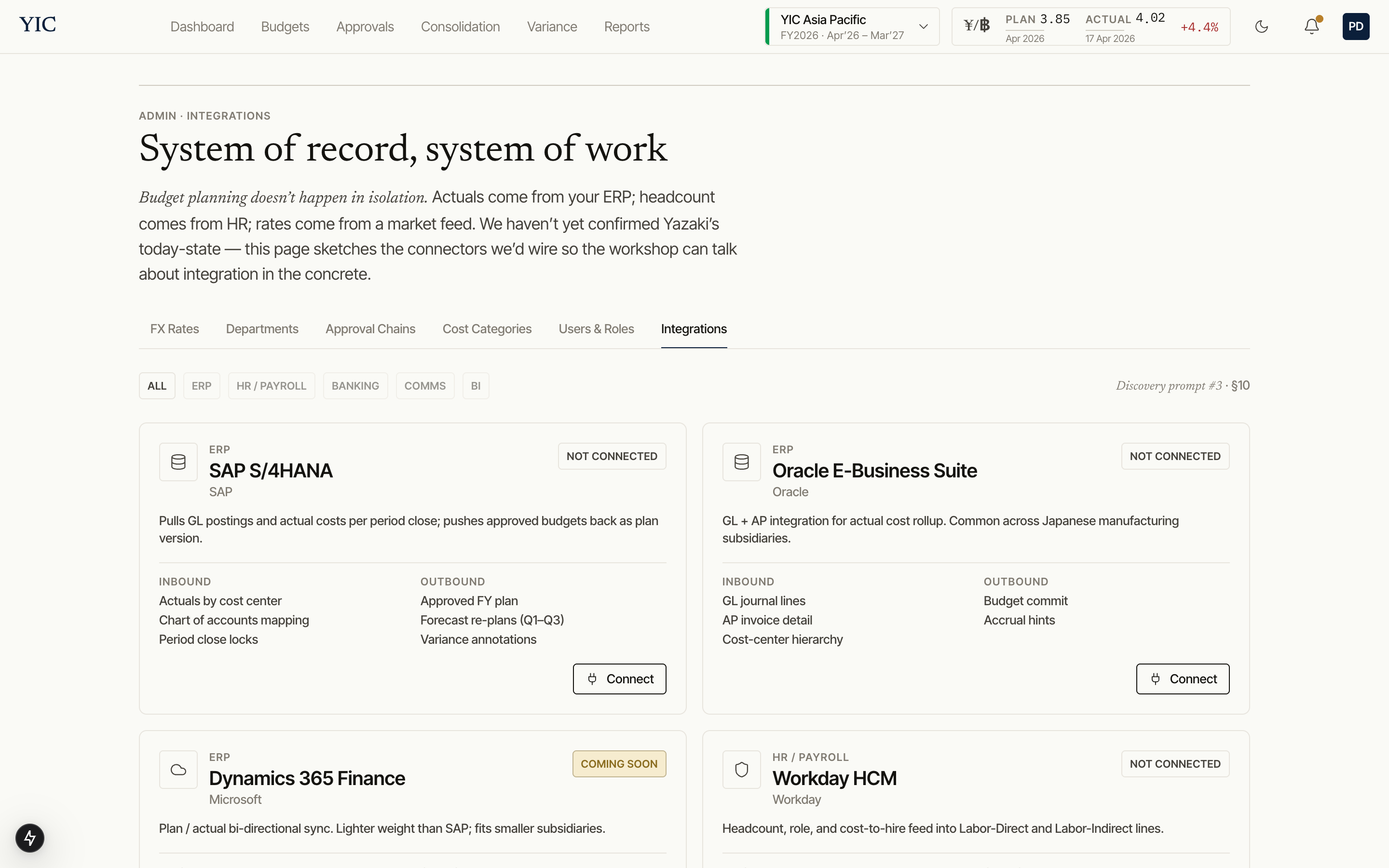
We haven't yet confirmed Yazaki's today-state. This page sketches the connectors we'd wire so the conversation can start from concrete mockups, not an empty square. Every row is labeled Not connected until we hear otherwise.
SAP S/4HANA · Oracle E-Business Suite · Dynamics 365
Workday HCM · Xero · Bloomberg FX (connected mock)
Slack · Teams · Power BI
PART III
The same app,
four points of view.
Role shapes what matters. Here's what each persona sees when they log in.
PERSONA · PHONGSAK (DEPT MANAGER · IT/BMS)
His own budget and three approvals waiting.
Phongsak's D-IT-BMS plan is still a draft — the MonstarX accelerator-tier license is flagged on line 56000, visible from the dashboard's activity feed. His approval inbox has three peer-dept reviews. He sees his own name in audit trails and comments.
- · Edits D-IT-BMS plan
- · Reviews 3 peer approvals routed to him
- · Notifications: 3 unread at login
PERSONA · SAEGUSA SHOJI (GM · 工場長)
The plant view.
Saegusa-san opens the dashboard and sees the full plant: ¥1.43B annual plan, YTD variance split at a glance, six departments. His signature is on D-FIN and D-HR approvals. When budgets cross THB 50M, the chain tells him HQ review is coming next.
- · Variance Overview is the daily read
- · Include/Exclude FX toggle separates signal from noise
- · Returns budgets with notes that land as prose in the timeline
PERSONA · SUWATCHAI APIWATANA (FINANCE)
Owns the rates. Publishes the reports.
Suwatchai sets the plan rate in February, updates the forecast at Q1, and monitors the Bloomberg feed for the actual. Every report is on her desk — the HQ FY Summary in Japanese taxonomy ships from here.
- · FX rates, rate audit log
- · Runs all 5 standing reports
- · Builds ad-hoc pivots for management
PERSONA · TANAKA HIROSHI (HQ REVIEWER · 本社)
Only sees budgets above threshold.
Tanaka-san sits in Tokyo. He appears in the approval chain only when a plant budget crosses THB 50M. His view emphasizes JPY, the HQ taxonomy, and cross-subsidiary consolidation.
- · HQ FY Summary is his primary document
- · Reviews D-MFG-HAR (180M) and D-ENG (62M) this cycle
- · No rate setting, no line edits — review-only
DESIGN SIGNALS
The craft is the product.
Typography is the hero. Density is the wow. Every animation is earned, never decorative. Grep-level discipline on palette and green placement.
Typography
¥1,432M
Newsreader for display numerics. Inter Tight for UI. IBM Plex Mono with tabular-nums for every column of figures.
Palette
Warm off-white paper. Navy brand. Ochre accent. Yazaki green restricted to 5 placements. No gradients.
Motion
4.02 → 4.15
Bar-reveal on first load (Wow 2). Slot-roll on FX change (Wow 1). Everything else is instant. No spinners.
WOW 3 + WOW 4
Mouse is optional.
Press ⌘K from anywhere to jump to any page, any department, any budget. Press ? for the full shortcut legend. It reads like Linear or Superhuman, not like an ERP.
- · Command palette groups: Recent · Navigate · Departments · Budgets · Actions
- · G-prefix mnemonics (G then D/B/A/V/R) for the power users
⌘K opens anywhere — even inside inputs.
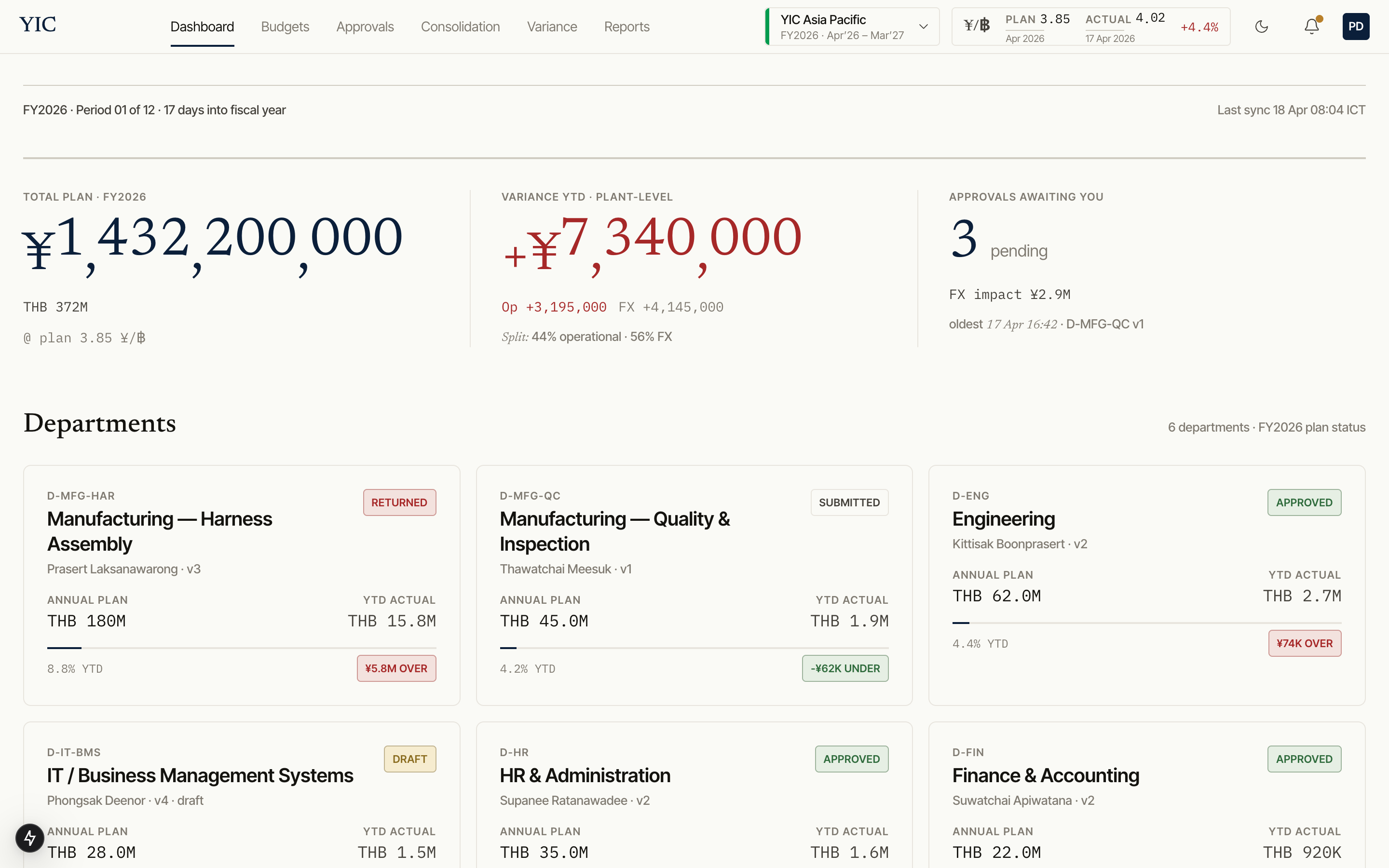
DARK VARIANT
Warm paper or warm paper at night.
Full dual-token palette under [data-theme='dark']. Never pure black — a warm near-black surface that reads like night-mode print. Every semantic color remapped for contrast.
HOW TO FURTHER ENHANCE THIS
From PoC to production — five moves.
Each enhancement is sequenced, scoped, and production-grade. The path from today's walkthrough to full rollout is weeks, not quarters — and every item below compounds the last.
THE ROADMAP
priced, sequenced, ready
01
Mobile & tablet.
Plant-floor access on iPad and phone. Inspectors, section managers, night-shift supervisors — the same data, adapted for the hand.
~2 WEEKS
02
Bulk import & export.
CSV in, Excel + PDF out. Years of historical actuals onboarded in minutes. HQ-ready reports, one click, Japanese taxonomy preserved.
~3 WEEKS
03
Live AI narrative.
Real-time commentary that updates on every rate change, with source-backed citations. Finance-controller voice preserved — editable, not overruling.
~4 WEEKS
04
Multi-entity consolidation.
Nana + Laem Chabang + Japan HQ rollup, across fiscal years. Group-level variance, cross-subsidiary benchmarking, year-over-year comparison built in.
~6 WEEKS
05
ERP & collaboration connectors.
One-click sync with SAP S/4HANA, Oracle, Dynamics 365. Slack + Teams approvals. Actuals flow from systems of record — no more manual reconciliation.
~8 WEEKS
Eight weeks to a fully-featured production system. We move as fast as your team can absorb.
PHASE 1 · PRODUCTION READY
WHAT YOU JUST SAW
A production-quality application.
WHAT IT DID
- Approval workflows.
- Consolidation — team to plant to company.
- Dual-currency reporting, THB and JPY.
- FX variance decomposition — operational vs FX.
- Live recalculation on rate change.
WHAT IT TOOK
Requirements~6 prompts
Designnot separate
Codesame prompts
Testinginline
Deploymentinstant
Total~1 working day
In your traditional cycle, this would be four to six months.
YOUR TURN
A
A daily shift log for your own team
who worked, what happened, any issues
B
A visitor check-in app for reception
name, host, time, badge
C
A simple supplier quality tracker
supplier, date, issue, resolution
D
Your choice — a problem on your GENBA
you'd love to poke at today
Nanthawat-san online — a template link is in the workshop chat.
BEFORE I SAY A WORD
What did the last
twenty minutes
feel like to you?
One sentence each. Round the room.
Saegusa-san, may I start with you?
NOW IMAGINE
Now imagine what you just did —
done by
100
people at Yazaki,
every month.
That is the GENBA building software at last. And if that is all you have, it is a disaster.
NOW THAT YOU'VE BUILT ONE — IMAGINE A HUNDRED
The same five problems. At scale.
One person building a tool is magic. One hundred people building a hundred tools — without a layer above — is a disaster in five shapes.
WHAT BREAKS AT 100×
and why orchestration matters
01
Shadow apps
Dozens, not five — and IT sees none of them.
02
Data leakage
Customer lists, P&L, in AI chat histories across departments.
03
Duplication
Four departments, four versions of the same tool.
04
Local only
The brilliant tool stays on one laptop.
05
Attrition
Resignations delete institutional knowledge.
AI made building cheap.
Enterprises need the layer above.
NOW YOU'VE SEEN WHY.
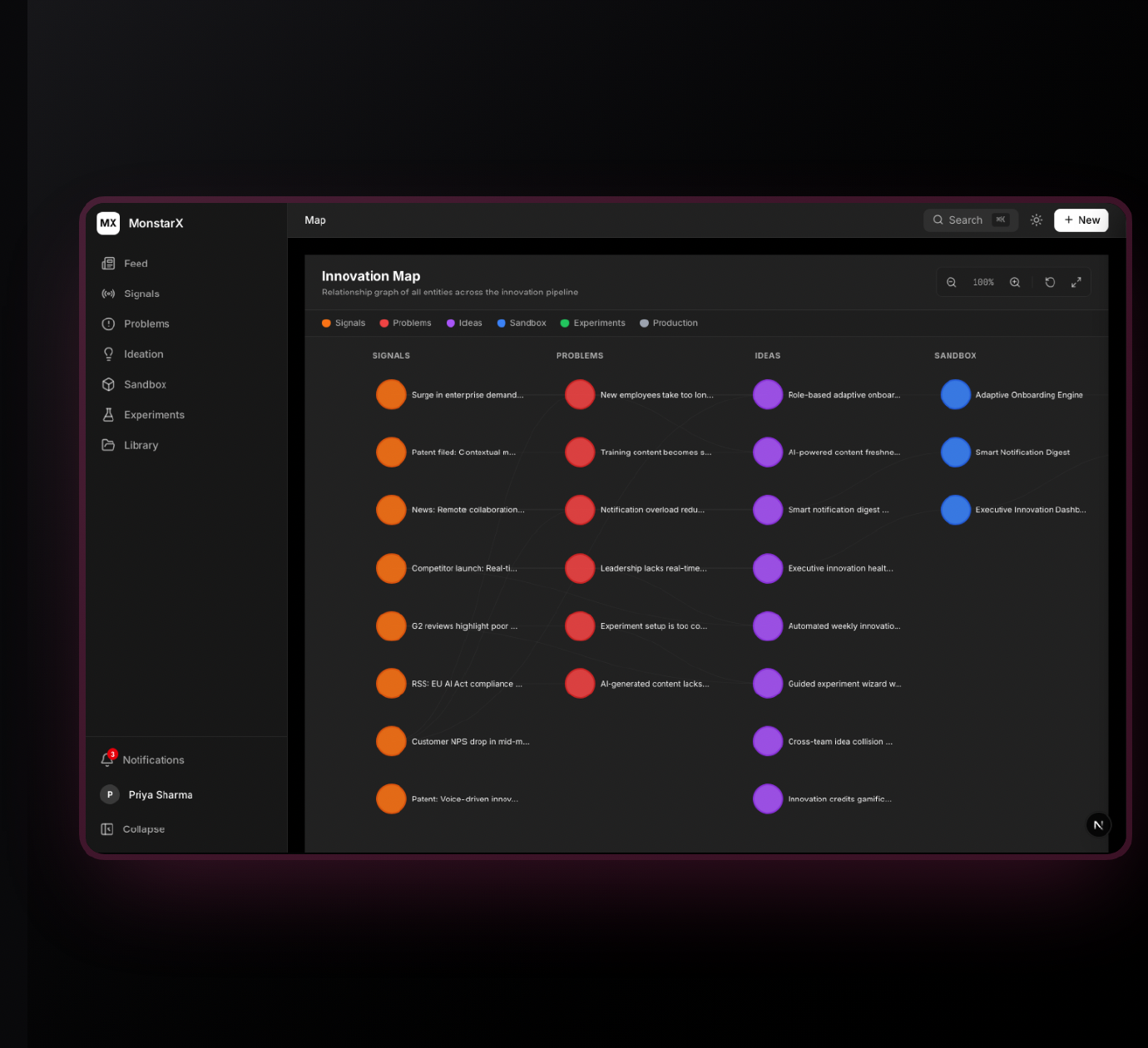
A TOUR OF THE PRODUCT
What we've been building, briefly.
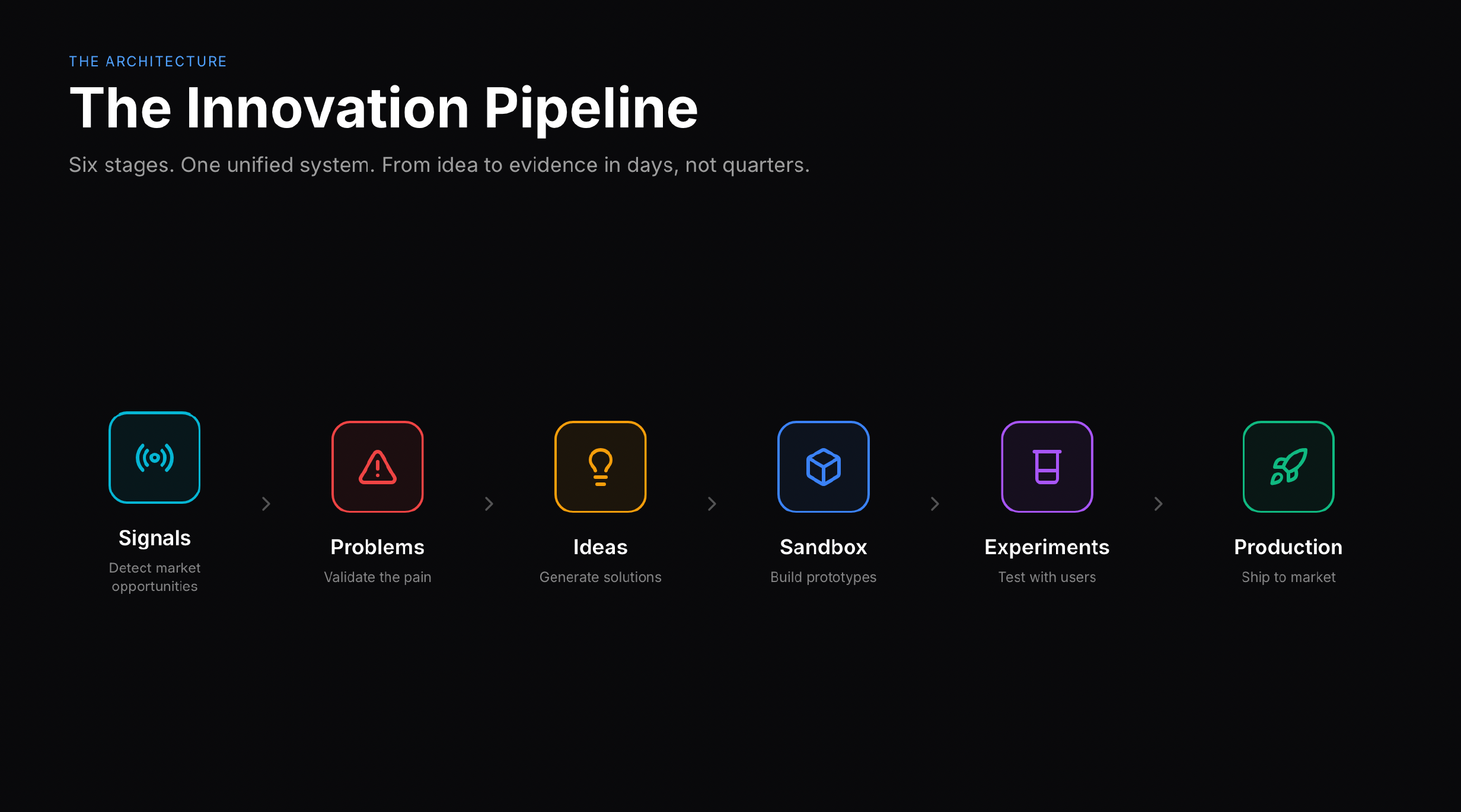
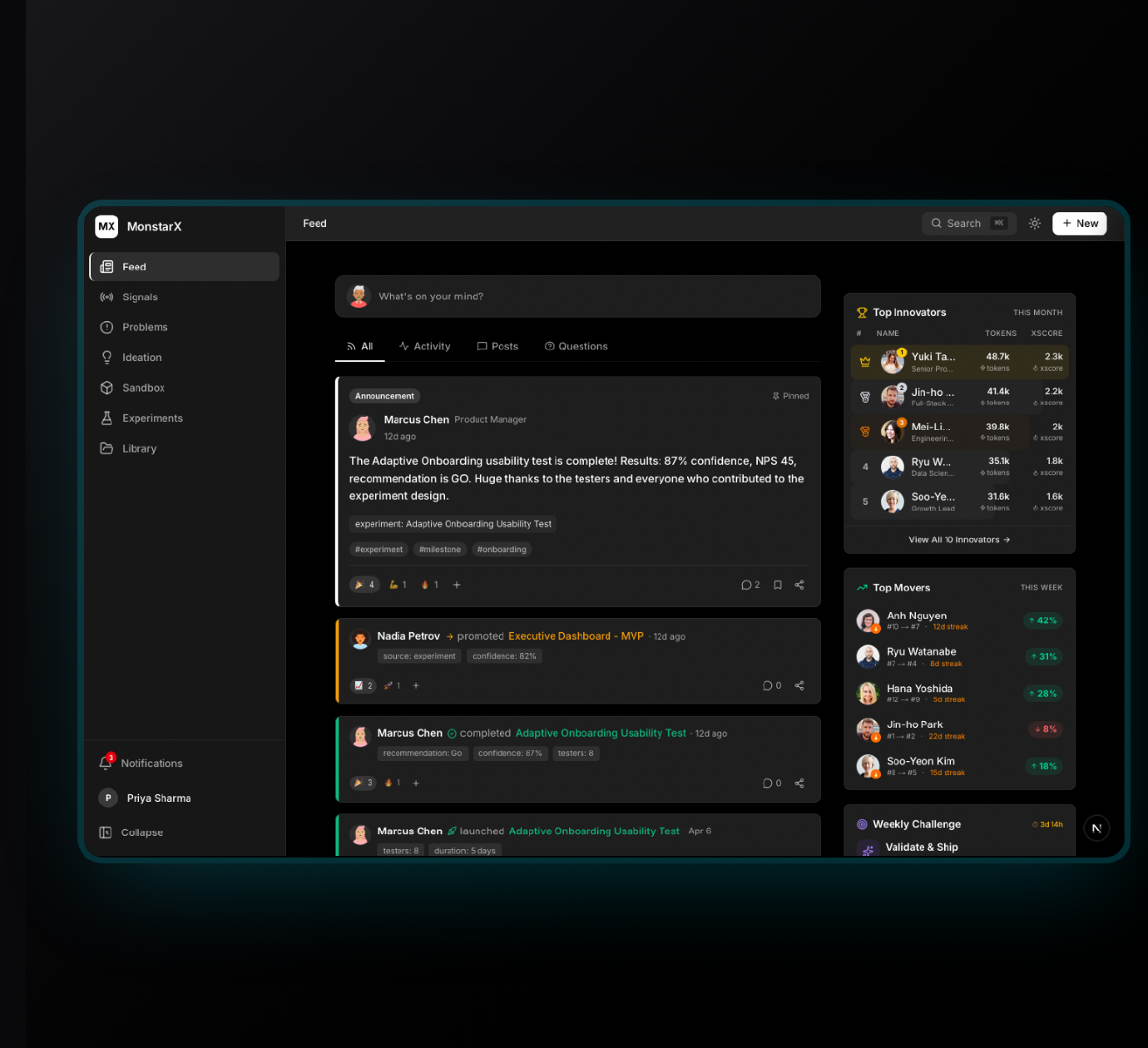
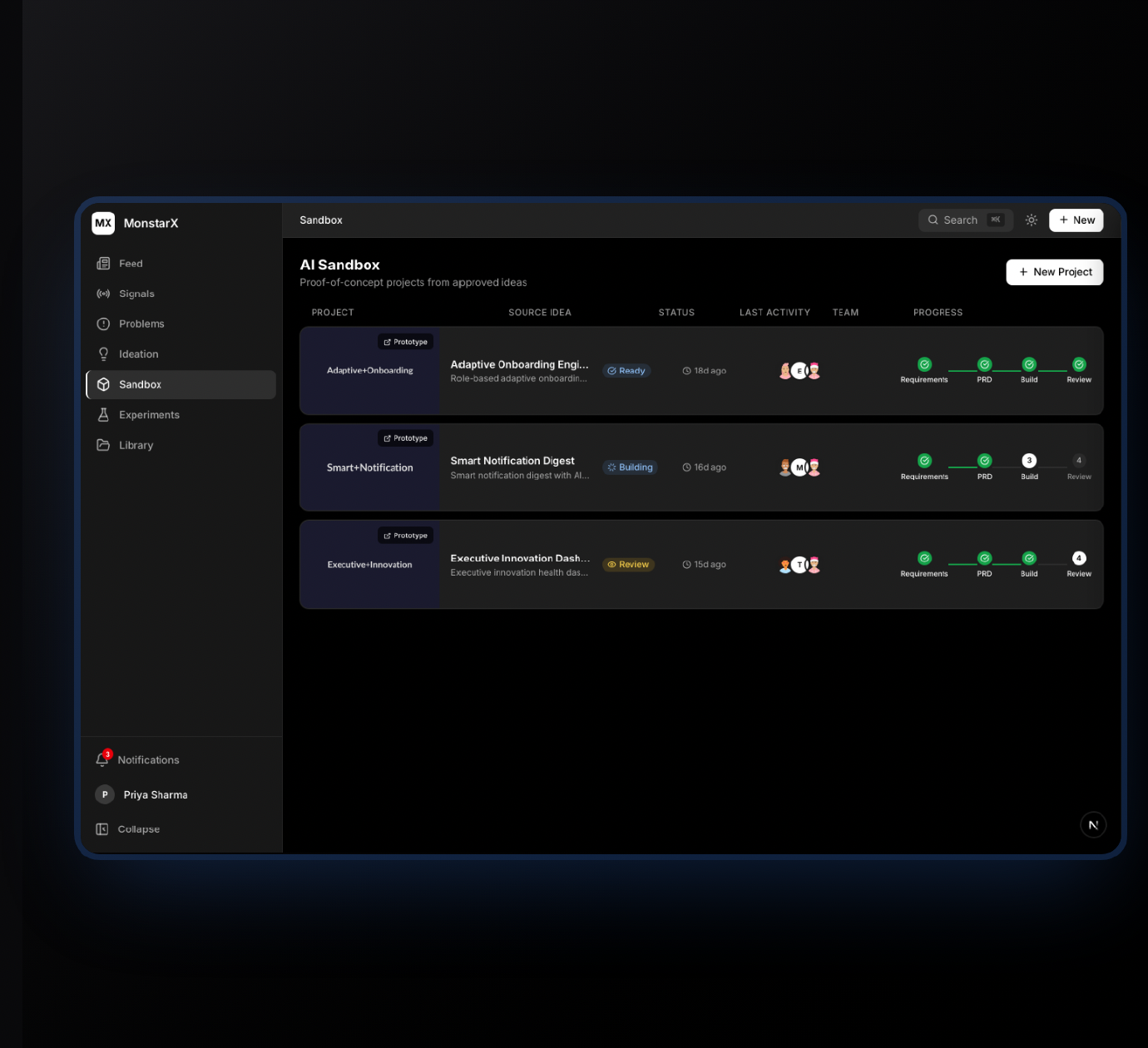
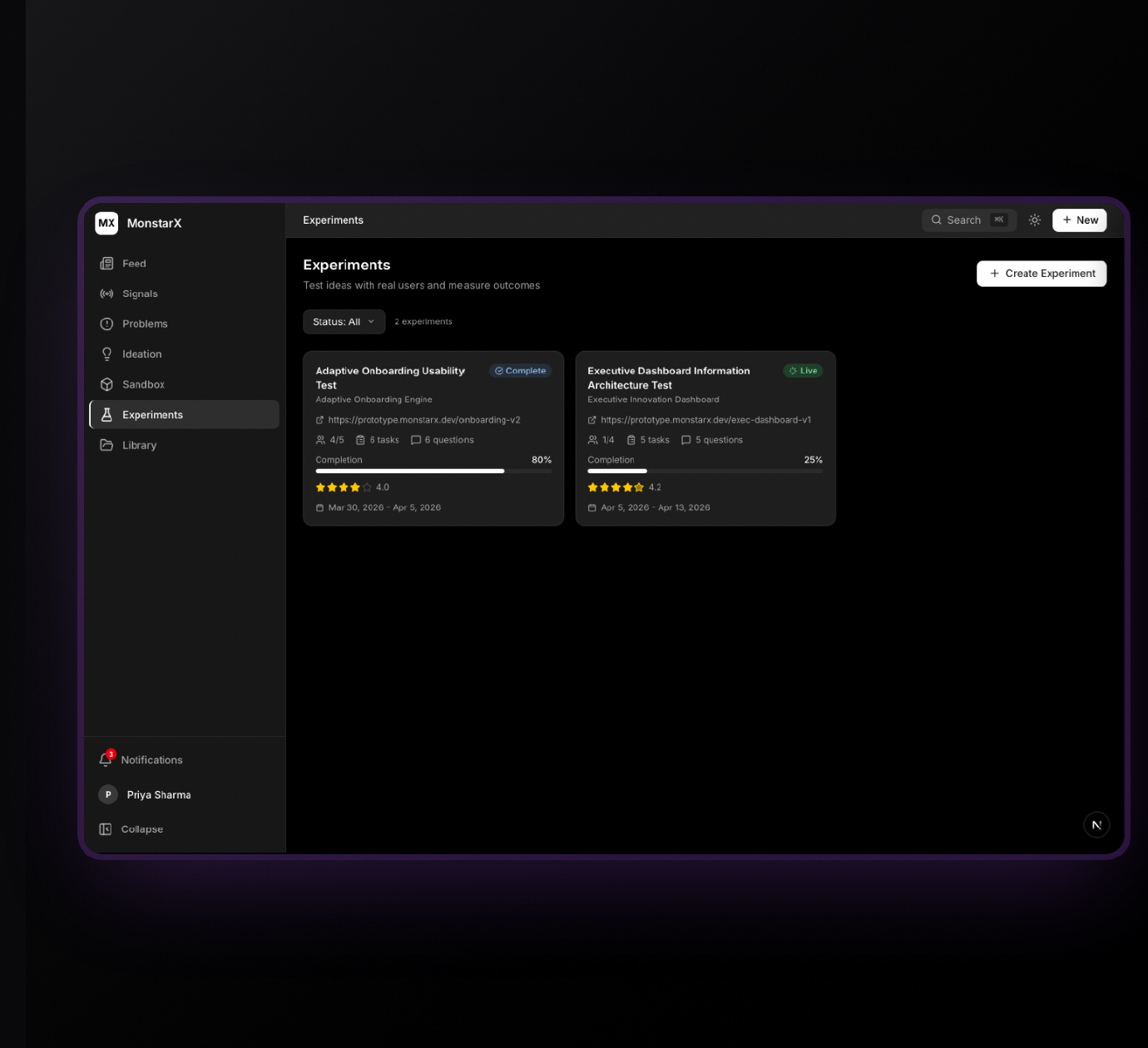
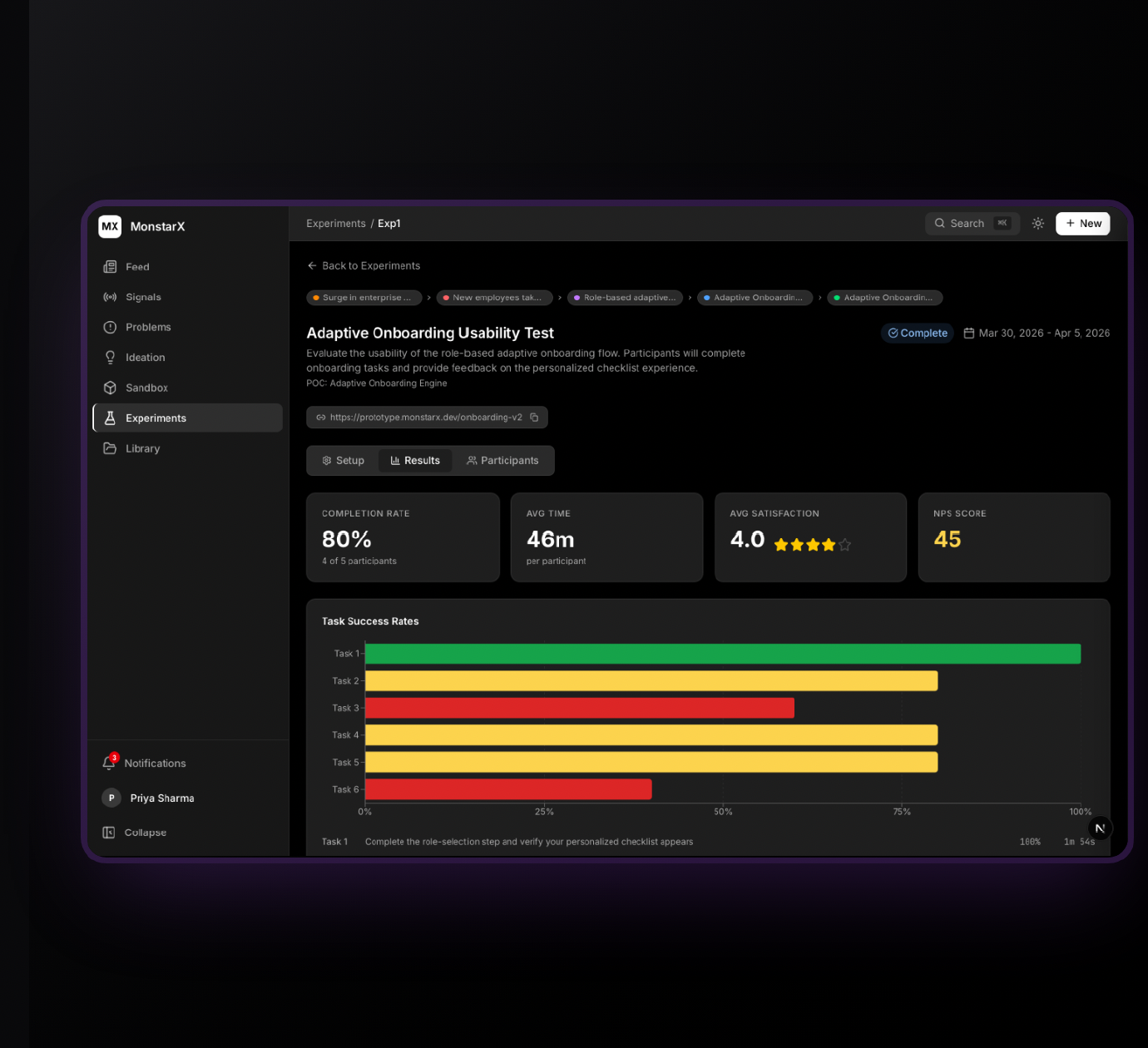
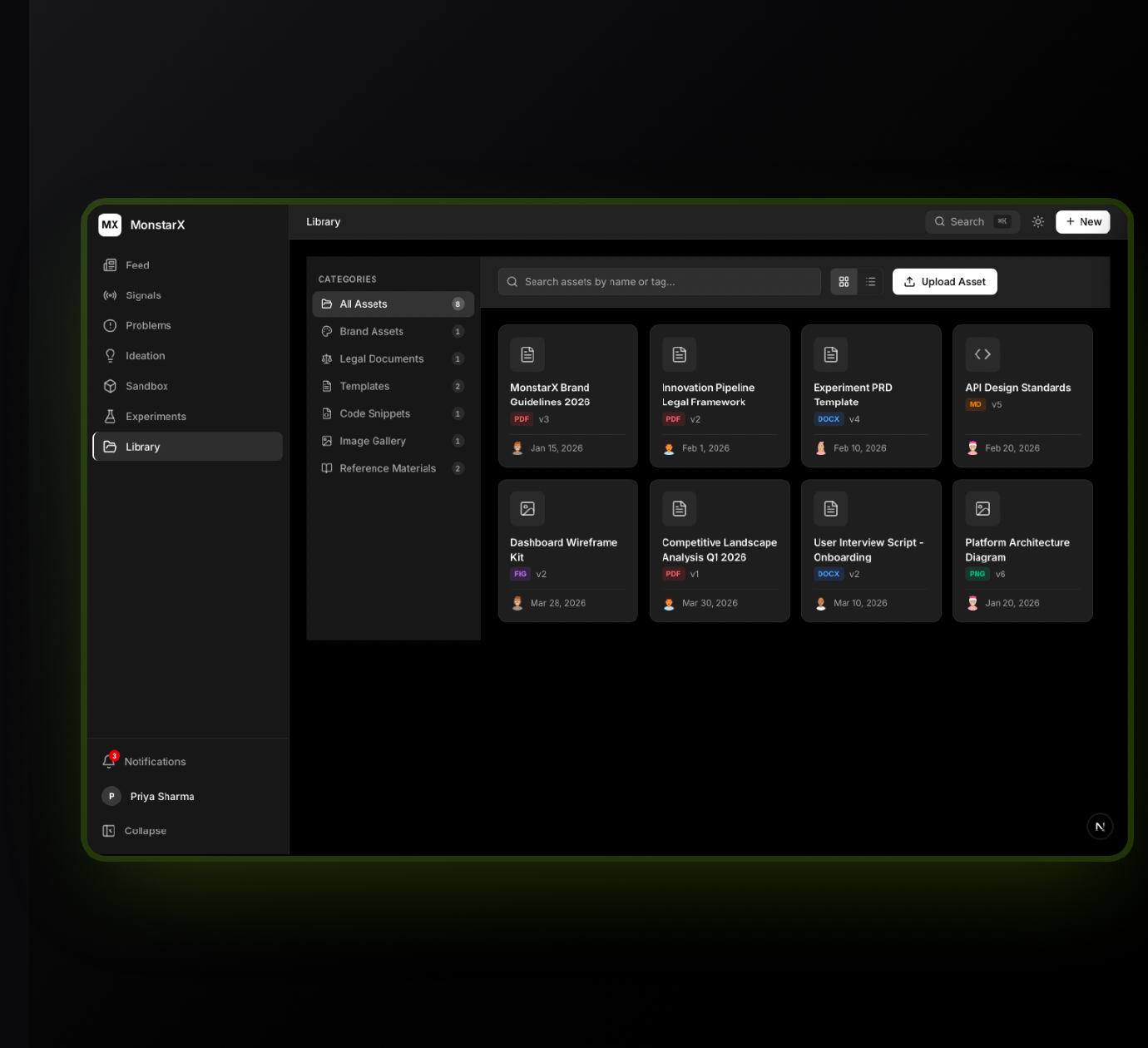
A product vision deck — one operating system for the full innovation pipeline, from signal to shipped. Six stages, one unified system.
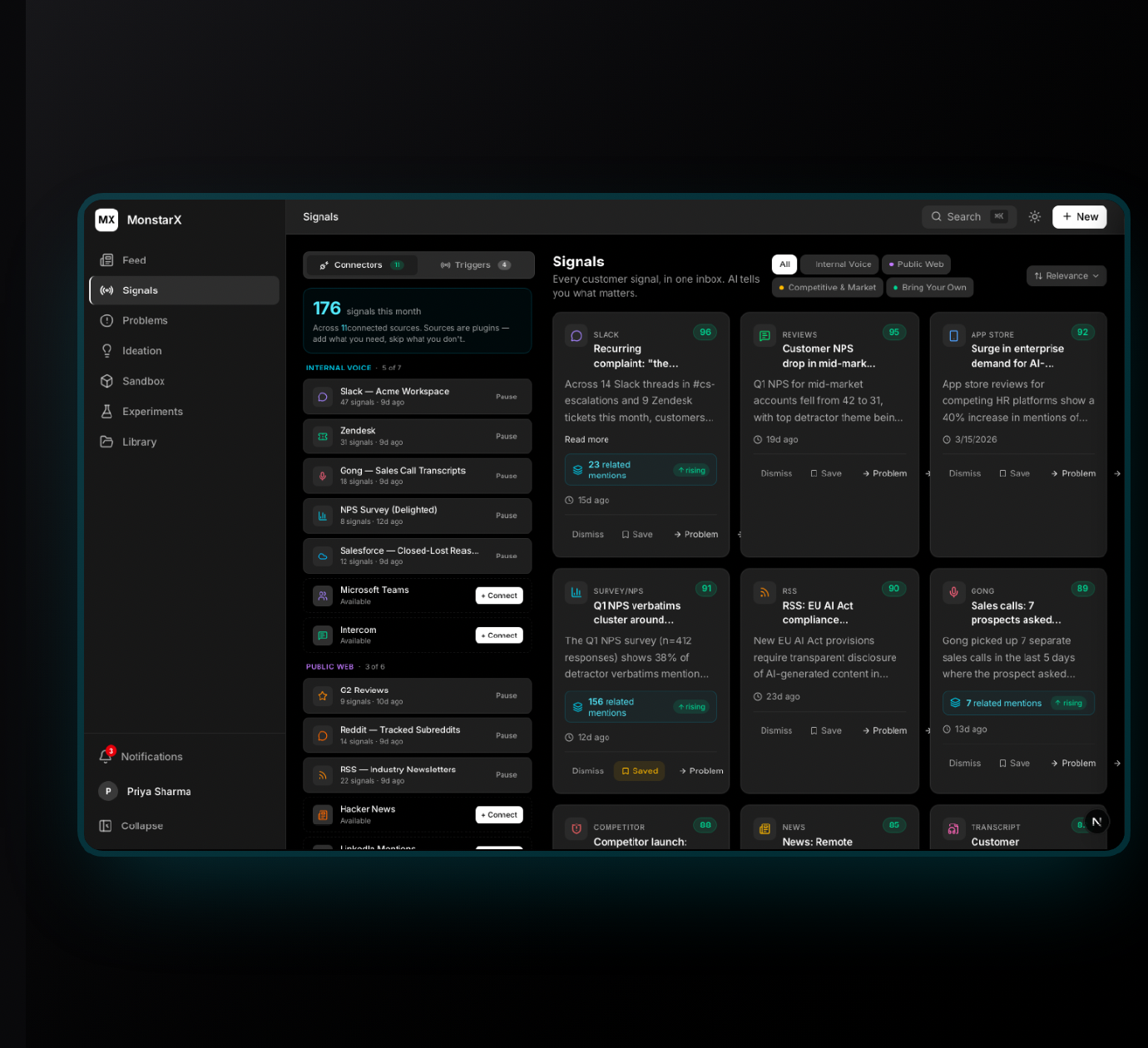
THE DAILY LAYER · AND THE SIGNAL IN
Where your people live — and where the pain arrives.
FROM IDEA · TO PROTOTYPE
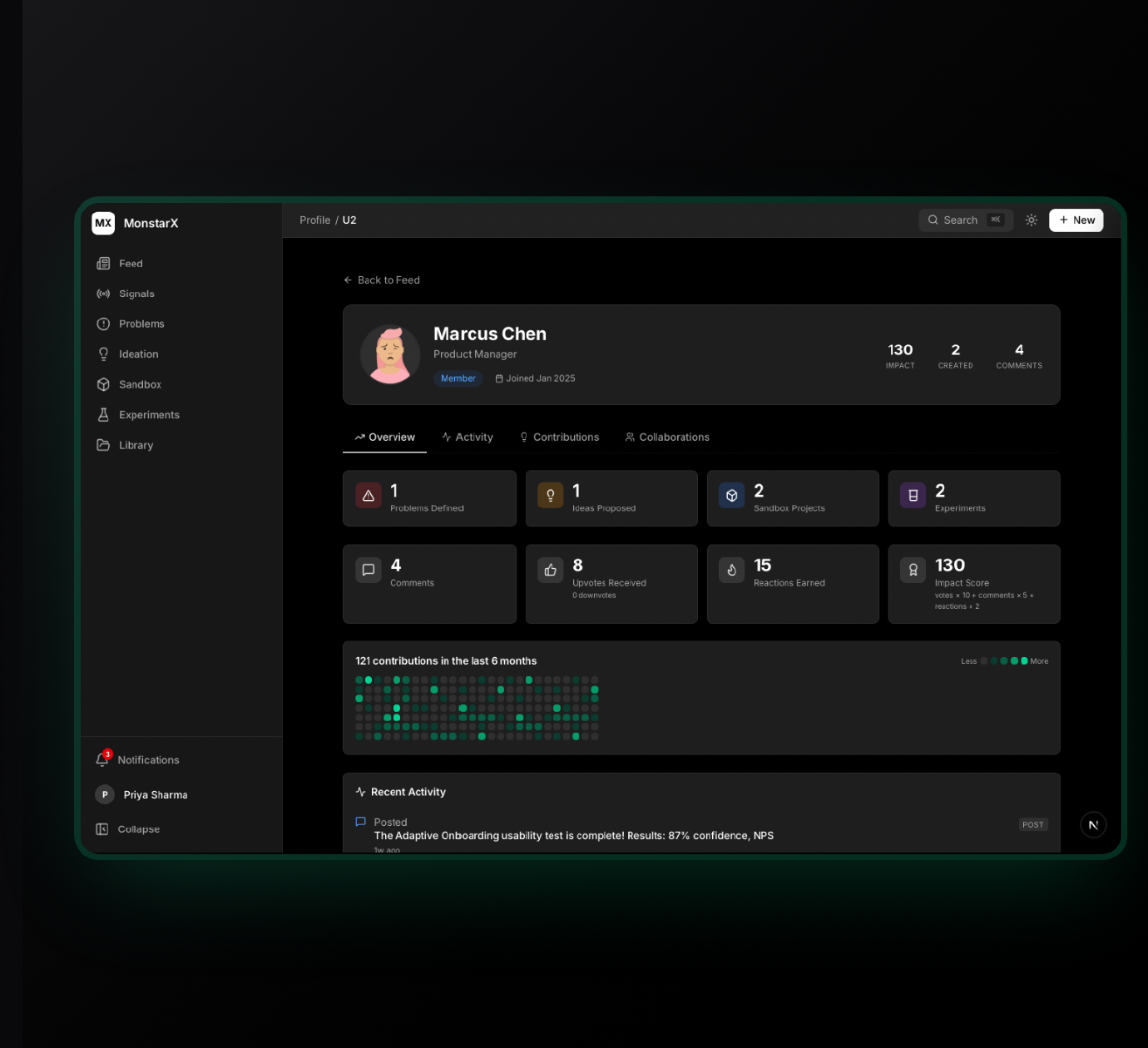
Validated pain becomes working software.
VALIDATE · AND INSTITUTIONALIZE
Real users. Real evidence. Never lost.
A PATH FROM TODAY
What working together could look like.
I.
MONTH 1
Founding partner.
Monstarlab Singapore and Yazaki formalize the relationship. MonstarX Enterprise Edition licenses for your innovation team. One structured workshop. Onboarding your developers.
II.
MONTHS 2 – 3
First PoC — your July budget system.
Delivered jointly. Real production timeline. Innovation OS in place from day one so Japan HQ has visibility throughout. A working system, not a prototype.
III.
MONTHS 4 – 6
Scale beyond IT.
GENBA hackathons across departments. Shadow-app consolidation. Portfolio visibility to Japan HQ. The model becomes a template.
BEFORE YOU LEAVE THE ROOM — TWO ASKS
I
Sixty minutes, in the next two weeks.
A proper working session on your real budget planning requirements. Not a sales meeting — you correct my guesses, we sharpen what a July delivery actually looks like, and we leave with an agreed scope.
II
One department — before end of May.
A GENBA hackathon. Two days. We bring engineers, you bring a real team with a real problem. At the end, they have working software.
CLOSE
Let's build
what's next — together.
What you saw was built in days. Imagine what we can ship in a quarter, alongside your team — the July budget system, production-ready. Pick the first sprint. We start when you do.